Table of Contents
Abstract
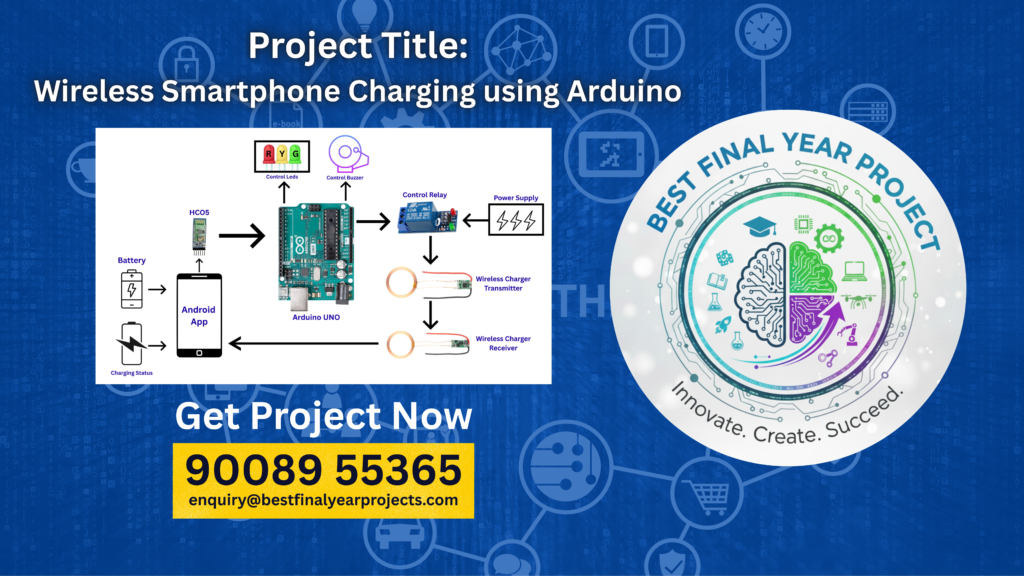
IoT projects ideas play a vital role in building smart and energy-efficient electronic systems. This project presents the design and implementation of a wireless smartphone charging system controlled using an Arduino microcontroller.
The system transfers power wirelessly through inductive coupling between a transmitter coil (charging pad) and a receiver coil placed inside or attached to the smartphone. This eliminates physical connectors and improves user convenience.
A Bluetooth module (HC-05) enables wireless communication between the Arduino and an Android application. The receiver unit monitors the battery percentage and charging status and sends real-time data to the microcontroller through Bluetooth.
Based on the received battery percentage, the system activates LED indicators—red for low charge, yellow for medium, and green for high charge levels. An I2C LCD display continuously shows charging status and battery percentage for better user interaction.
To enhance battery safety and lifespan, a relay module automatically disconnects the power supply when the battery reaches 95% charge, preventing overcharging. This project demonstrates an efficient, safe, and smart wireless charging solution suitable for modern IoT-based applications.
Introduction
Iot projects ideas are increasingly focused on improving user convenience through smart and contactless technologies. Wireless charging uses electromagnetic induction to transfer power between a transmitter coil in a charging pad and a receiver coil embedded within a smartphone. This method eliminates physical connectors, reducing wear, cable damage, and user effort while improving reliability and safety.
This project implements a compact wireless smartphone charging system using inductive transmitter and receiver modules controlled by an Arduino microcontroller. An HC-05 Bluetooth module enables real-time wireless communication between the smartphone and the Arduino, allowing battery percentage and charging status to be continuously monitored.
To enhance user interaction and safety, the system employs LED indicators to show battery levels and an I2C LCD to display charging information in real time. A relay module intelligently disconnects the charging pad once the battery reaches 95%, preventing prolonged overcharging and improving battery lifespan.
By integrating embedded control, wireless power transfer, and mobile application communication, this project transforms a conventional charger into a smart charging station. Such Iot projects ideas demonstrate how affordable hardware and software integration can deliver intelligent, adaptive, and safer charging solutions for modern smartphones.
Objectives
Iot projects ideas emphasize smart automation and user safety in modern electronic systems. The primary objective of this project is to design and implement a functional wireless smartphone charging prototype using an Arduino microcontroller and inductive power transfer.
The system aims to transmit battery percentage and charging status from a smartphone to an Android application and forward this data to the Arduino via Bluetooth (HC-05). Real-time charging information is displayed using an I2C LCD module for better monitoring.
Another objective is to visually indicate battery levels using red, yellow, and green LEDs corresponding to low, medium, and high charge states. The project also focuses on automatically disconnecting the charging supply through a relay when the battery reaches 95%, enhancing battery health. These goals highlight practical Iot projects ideas centered on safety, efficiency, and intelligent control.
Problem Statement
Iot projects ideas increasingly focus on improving battery safety and intelligent power management in portable devices. Smartphone batteries tend to degrade faster when they are frequently charged to full capacity or kept at 100% charge for long durations. Many users forget to disconnect chargers, and wireless power transfer systems may continue supplying energy even after the battery is fully charged.
Although modern smartphones include internal protection circuits, prolonged exposure to full-charge conditions can still reduce battery lifespan. There is a need for an external, automated control mechanism that actively monitors battery percentage and disconnects the power supply before overcharging occurs.
This project addresses the issue by developing a low-cost, automated wireless charging control system using an Arduino and readily available hardware modules. Such Iot projects ideas enhance charging safety, efficiency, and long-term battery health through smart cutoff mechanisms.
Existing System Drawbacks
Iot projects ideas often reveal that most existing wireless smartphone charging systems are limited to basic Qi-based inductive power transfer. These systems require accurate alignment between the transmitter and receiver coils to maintain efficient energy transfer. Even slight misalignment can reduce charging efficiency, generate excess heat, or interrupt charging altogether.
Commercial wireless chargers generally operate in a fixed-power transmission mode. Once a compatible device is detected, the charging pad continuously supplies power without considering real-time battery percentage, charging duration, or long-term battery health. The charger depends entirely on the smartphone’s internal battery management system (BMS) for protection, while the charging hardware itself has no awareness of battery status or user-defined preferences.
Another major drawback is the lack of dynamic communication between the smartphone and the charger. Standard Qi modules do not exchange detailed information such as battery percentage, temperature, or charging state. As a result, charging continues until the battery reaches 100%, followed by periodic trickle charging. This prolonged high-voltage state accelerates battery degradation and increases thermal stress, especially during overnight charging.
Additionally, existing wireless chargers do not integrate external microcontroller-based control mechanisms. Features such as relay-based power cutoff, Bluetooth-enabled monitoring, LCD status display, or configurable charge thresholds are absent. This limits automation, remote supervision, and customization. These shortcomings clearly demonstrate the need for smarter Iot projects ideas that enhance safety, intelligence, and adaptability in wireless charging systems.
Key Drawbacks Summary
- Manual monitoring required by users
- Continuous trickle charging after full charge
- No real-time or remote battery monitoring
- Increased heat and EMI risks in low-cost modules
- No external automation or user-defined cutoff control
Proposed System Advantages
Iot projects ideas that focus on intelligent automation significantly improve the safety and efficiency of everyday electronic systems. The proposed wireless smartphone charging system introduces a smart, Arduino-controlled architecture that overcomes the limitations of conventional wireless chargers by combining real-time monitoring, Bluetooth communication, and automated power control.
Unlike traditional chargers that operate blindly, this system continuously receives battery percentage and charging status from an Android application using built-in battery APIs. The data is transmitted to the Arduino through the HC-05 Bluetooth module, enabling the charging hardware to make informed decisions based on actual battery conditions. This context-aware behavior is a key advantage in modern Iot projects ideas, where adaptability and responsiveness are essential.
The system provides clear and immediate user feedback through multiple interfaces. LED indicators display battery levels using red, yellow, and green signals, while an I2C LCD shows real-time battery percentage and charging status. This dual feedback mechanism enhances usability and reduces the need for manual monitoring.
A major advantage of the proposed system is its automatic cutoff mechanism. When the battery reaches a predefined safe threshold of 95%, the Arduino activates a relay to disconnect power to the wireless charging transmitter. This prevents prolonged exposure to full charge, reduces heat generation, and significantly improves battery lifespan. Such intelligent cutoff control highlights how Iot projects ideas can enhance energy efficiency and device safety using simple, low-cost components.
The modular design of the system allows easy expansion. Future enhancements such as temperature sensing, data logging, advanced charge negotiation, or cloud-based IoT integration can be implemented without redesigning the core architecture. Overall, the proposed system transforms a basic wireless charger into a smart, automated, and user-centric charging solution.
Key Advantages Summary
- Automatic cutoff at configurable threshold (95%) to protect battery health
- Real-time remote monitoring via Android application
- Low-cost and easily available hardware components
- Clear visual feedback using LEDs and LCD display
- Modular and scalable design for future IoT enhancements
Hardware Requirements
Iot projects ideas often rely on simple, reliable, and easily available hardware components for rapid prototyping and experimentation. The proposed wireless smartphone charging system is built using an Arduino microcontroller, which acts as the central control unit and manages communication, display, and power cutoff operations.
An inductive wireless charging transmitter module is used to generate the alternating magnetic field, while a compatible wireless charging receiver module captures the energy on the smartphone side or a test load. Bluetooth communication between the smartphone and controller is achieved using the HC-05 module, enabling real-time battery data exchange, which is essential in advanced Iot projects ideas focused on automation.
A 5V relay module is employed to safely disconnect the charging power when the battery reaches the defined threshold. User feedback is provided through a 16×2 I2C LCD (with PCF8574 backpack) and three LEDs—red, yellow, and green—each connected with current-limiting resistors. Supporting components include connecting wires, a breadboard or PCB, and a suitable power adapter. Optional tools such as a multimeter, oscilloscope, and ferrite shielding help improve reliability and debugging in practical Iot projects ideas.
Hardware List
- Arduino UNO / Nano / Pro Mini
- Wireless charging transmitter module
- Wireless charging receiver module
- HC-05 Bluetooth module
- 5V relay module
- 16×2 I2C LCD with PCF8574
- Red, Yellow, Green LEDs with 220Ω resistors
- Breadboard, jumper wires, power adapter
- Optional: multimeter, oscilloscope, ferrite sheets
Arduino Uno
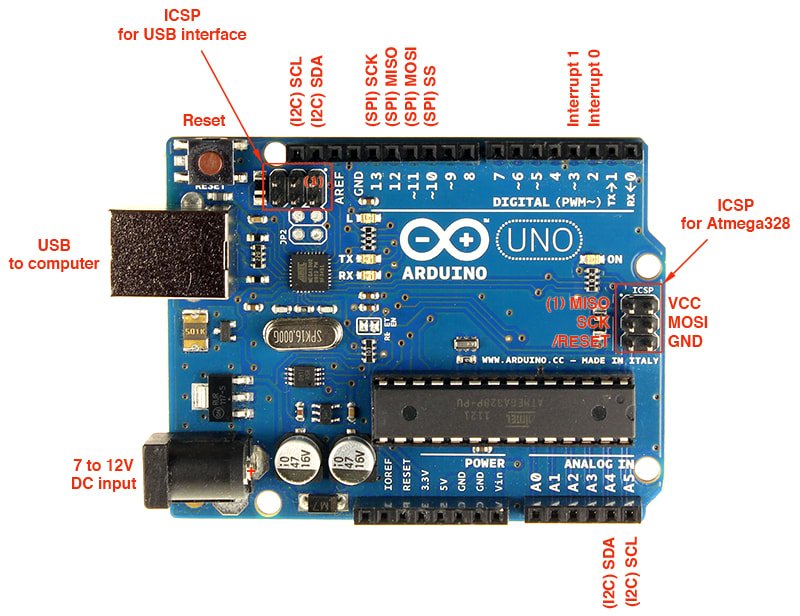
Iot projects ideas frequently use the Arduino Uno as a core controller due to its simplicity, flexibility, and wide community support. Arduino is an open-source microcontroller development board that allows users to read sensor inputs and control real-world outputs such as LEDs, motors, relays, and displays. By uploading programs to the board, the Arduino can interact intelligently with its environment, making it ideal for automation and embedded system applications.
The Arduino platform was first introduced in 2005 by David Cuartielles and Massimo Banzi with the goal of providing a low-cost and easy-to-use development board for students, hobbyists, and professionals. Since its introduction, Arduino has become one of the most popular platforms for Iot projects ideas, prototyping, and educational learning. Its affordability and open-source nature allow users to either purchase ready-made boards or build customized versions using basic electronic components.
The Arduino Uno is based on the ATmega328P microcontroller and features 14 digital input/output pins, of which 6 support Pulse Width Modulation (PWM), along with 6 analog input pins. It also includes a USB interface, power jack, 16 MHz crystal oscillator, reset button, and ICSP header. The board can be powered through a USB connection or an external supply ranging from 7V to 12V, making it suitable for standalone Iot projects ideas and portable systems.
Advantages of Arduino Technology
- Low cost and easily available
- Open-source hardware and software platform
- Compatible with Windows, Linux, and macOS
- Large community support and extensive libraries
- Simple and beginner-friendly programming environment
Because of these features, Arduino Uno is widely used in communication systems, automation projects, robotics, and smart charging applications.
LCD 16×2 Display
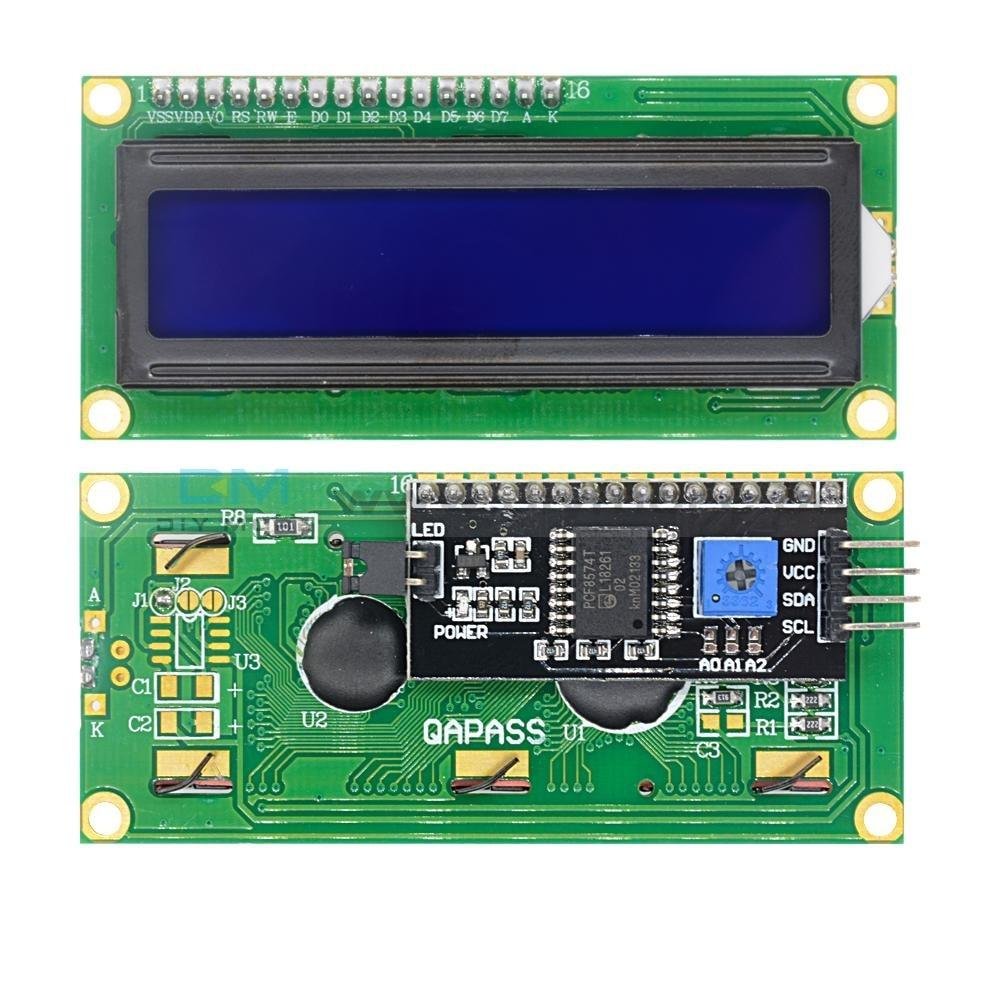
Iot projects ideas often require a simple and efficient way to display real-time system information, and the 16×2 LCD with I2C interface serves this purpose effectively. This display module can show 16 characters per line across two lines, featuring white text on a blue backlit background, making it easy to read in various lighting conditions.
In conventional Arduino LCD projects, a large number of digital pins are consumed, which becomes a limitation when using compact boards like the Arduino Uno. The I2C-based 16×2 LCD overcomes this issue by using only four connections: VCC, GND, SDA, and SCL. This significantly reduces wiring complexity and frees up Arduino pins for other peripherals, which is highly beneficial in complex Iot projects ideas involving multiple modules.
The LCD module comes with a PCF8574 I2C backpack that allows serial communication between the Arduino and the display. All connectors are standard 2.54 mm breadboard-compatible headers, enabling quick connections using jumper wires without soldering. An adjustable contrast potentiometer is also provided to fine-tune display visibility.
Due to its low power consumption, simple interface, and clear output, this LCD module is widely used in monitoring dashboards, smart charging systems, and embedded Iot projects ideas that require real-time user feedback.
Specifications
- Compatible with Arduino UNO, Leonardo, Mega, Nano, Mini, and Micro
- I2C Address Range: 0x20–0x27 (default 0x20)
- Display Type: 16×2 characters
- Backlight: Blue with white characters
- Supply Voltage: 5V
- Interface: I2C / TWI
- Adjustable contrast control
- Dimensions: 80 × 36 × 20 mm
LEDs
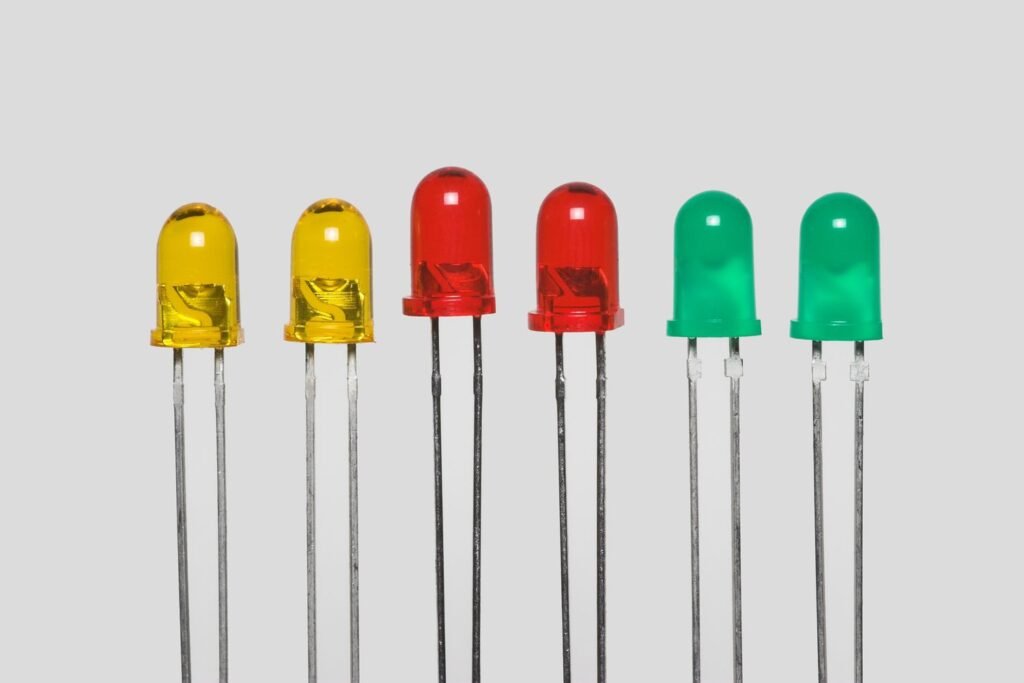
Iot projects ideas commonly use Light Emitting Diodes (LEDs) as simple yet effective visual indicators. LEDs are compact, energy-efficient light sources widely used to display system states such as power status, errors, and operating conditions in embedded and automation systems.
An LED has polarity, meaning it must be connected correctly to function. The longer lead represents the positive terminal (anode), while the shorter lead, usually located near the flat edge of the LED casing, indicates the negative terminal (cathode). Correct polarity is essential for reliable operation in Iot projects ideas and embedded circuits.
To protect LEDs from excessive current, a resistor must always be connected in series. Without a current-limiting resistor, the LED may draw excessive current and burn out quickly. Resistor values typically range from 100 Ω to 10 kΩ. Lower resistance values allow higher current, resulting in brighter illumination, while higher resistance values reduce current and produce dimmer light. Selecting an appropriate resistor ensures safe operation and long lifespan of LEDs in practical Iot projects ideas.
In this project, red, yellow, and green LEDs are used to indicate low, medium, and high battery charge levels, providing immediate and intuitive visual feedback.
void setup()
{  // initialize digital pin 13 as an output.
   pinMode(2, OUTPUT);
}

// the loop function runs over and over again forever

void loop()
{
   digitalWrite(2, HIGH); // turn the LED on (HIGH is the voltage level)
   delay(1000); // wait for a second
   digitalWrite(2, LOW); // turn the LED off by making the voltage LOW
   delay(1000); // wait for a second
}


int pwm = 11;                   // This is the pin that we will use

void setup()
{
    pinMode(pwm, OUTPUT);       // declare the pin to be an output
}

void loop()
{
    analogWrite(pwm, 255);      // maximum brightness (100%)
    delay(750);
    analogWrite(pwm, 127);      // medium brightness (50%)
    delay(750);
    analogWrite(pwm, 0);      // minimum brightness (0%)
    delay(750);
}