
Table of Contents
Introduction
The Smart Campus Management System is an advanced digital framework designed to modernize and automate campus operations in higher education institutions. In the context of Indian colleges, where administrative load, large student populations, and manual workflows are common, the Smart Campus Management System provides a unified digital platform that connects administrators, faculty members, students, and parents within a single ecosystem.
With the rapid adoption of Industry 4.0 technologies, educational institutions are under increasing pressure to move beyond traditional paper-based processes. The Smart Campus Management System replaces fragmented manual systems with integrated digital modules powered by IoT, cloud computing, and data analytics. This transformation enables real-time monitoring, transparent communication, and data-driven decision-making across the campus.
Technically, the Smart Campus Management System is built using a scalable three-tier architecture with Python Flask as the backend framework and MySQL as the database layer. Advanced features such as biometric face recognition attendance, automated notifications, and analytical dashboards enhance operational accuracy and efficiency. The system supports academic management, attendance tracking, library services, infrastructure monitoring, and secure access control.
By eliminating communication gaps between stakeholders and centralizing institutional data, the Smart Campus Management System establishes a future-ready digital campus environment. This approach not only improves current operational efficiency but also creates a strong foundation for long-term technological expansion in Indian educational institutions.
Problem Statement
Educational institutions in India continue to face operational inefficiencies due to outdated campus management practices. The absence of an integrated Smart Campus Management System results in excessive paperwork, delayed information flow, and frequent human errors in attendance, grading, and reporting.
One of the most significant challenges is delayed communication. Parents often receive attendance or performance updates long after issues arise, reducing the effectiveness of corrective action. Faculty and administrative coordination also suffers due to fragmented communication channels, creating confusion during timetable changes or emergency situations. Without a centralized Smart Campus Management System, institutions struggle to maintain transparency and responsiveness.
Attendance management is another critical concern. Manual registers are prone to proxy attendance and record manipulation. The lack of real-time attendance alerts prevents timely interventions by parents and administrators. Additionally, resource monitoring is largely reactive, leading to delayed maintenance, increased operational costs, and inefficient infrastructure usage.
Library operations in traditional systems rely on manual tracking, causing delays in availability checks, inaccurate fine calculations, and poor resource utilization. Security risks further arise due to weak access control mechanisms, lack of audit trails, and vulnerability to unauthorized data access. These limitations highlight the urgent need for a secure, scalable Smart Campus Management System.
Existing System
Most colleges currently operate using isolated departmental systems that lack integration. In the absence of a centralized Smart Campus Management System, data is stored across multiple platforms, resulting in redundancy and inconsistency.
Manual record-keeping dominates attendance tracking, academic documentation, and administrative workflows. These processes consume significant time and are highly susceptible to errors. Since existing systems lack real-time data processing, stakeholders often rely on outdated information for decision-making.
Communication methods such as notice boards, emails, and periodic meetings fail to support instant updates. Attendance reporting to parents is delayed, library services are slow due to manual entries, and infrastructure monitoring depends on periodic checks rather than real-time alerts. Financially, these inefficiencies increase staffing costs, stationery expenses, and opportunity losses due to administrative delays.
Overall, the lack of a unified Smart Campus Management System prevents institutions from achieving operational excellence and digital maturity.
Proposed System
The proposed Smart Campus Management System introduces a centralized, web-based platform that integrates all campus operations into a single digital solution. Accessible from any internet-enabled device, the system ensures convenience and transparency for all stakeholders.
Key Features of the Smart Campus Management System
- Role-based access for administrators, HODs, faculty, parents, and students
- Real-time database synchronization across modules
- Face recognition–based biometric attendance
- Automated notifications and alerts
- Smart library management
- IoT-enabled infrastructure monitoring
The Smart Campus Management System enables administrators to monitor campus performance through analytical dashboards, while faculty benefit from simplified attendance and academic management tools. Parents receive real-time updates on attendance and academic progress, and students gain easy access to schedules, resources, and performance reports.
The modular architecture supports phased implementation and future scalability, making the Smart Campus Management System ideal for Indian colleges planning long-term digital transformation.
Objectives of the Smart Campus Management System
Primary Objectives
The primary goal of the Smart Campus Management System is to create a unified digital ecosystem that replaces manual processes with automated workflows. It aims to enhance real-time communication, improve data accuracy, and strengthen institutional transparency.
Technical Objectives
Technically, the Smart Campus Management System focuses on scalability, secure architecture, RESTful APIs, biometric attendance integration, and IoT-based monitoring. Performance optimization and high system availability remain key priorities.
Functional Objectives
Functionally, the system supports automated attendance tracking, academic scheduling, digital library management, parent portals, and performance analytics. Each function is designed to reduce workload and improve service efficiency.
Operational Objectives
Operationally, the Smart Campus Management System reduces paperwork, optimizes resource usage, and enables data-driven decision-making through advanced reporting tools.
Stakeholder-Specific Objectives
- Administrators: Complete institutional oversight
- Faculty: Reduced administrative burden
- Parents: Transparent academic monitoring
- Students: Easy access to academic resources
Quality Objectives
The system emphasizes reliability, usability, security, and compliance with data protection standards.
Featured Snippet: What is a Smart Campus Management System?
A Smart Campus Management System is a centralized digital platform that automates academic, administrative, and infrastructure operations in educational institutions using IoT, cloud computing, and data analytics to improve efficiency and communication.
System Design & Architecture
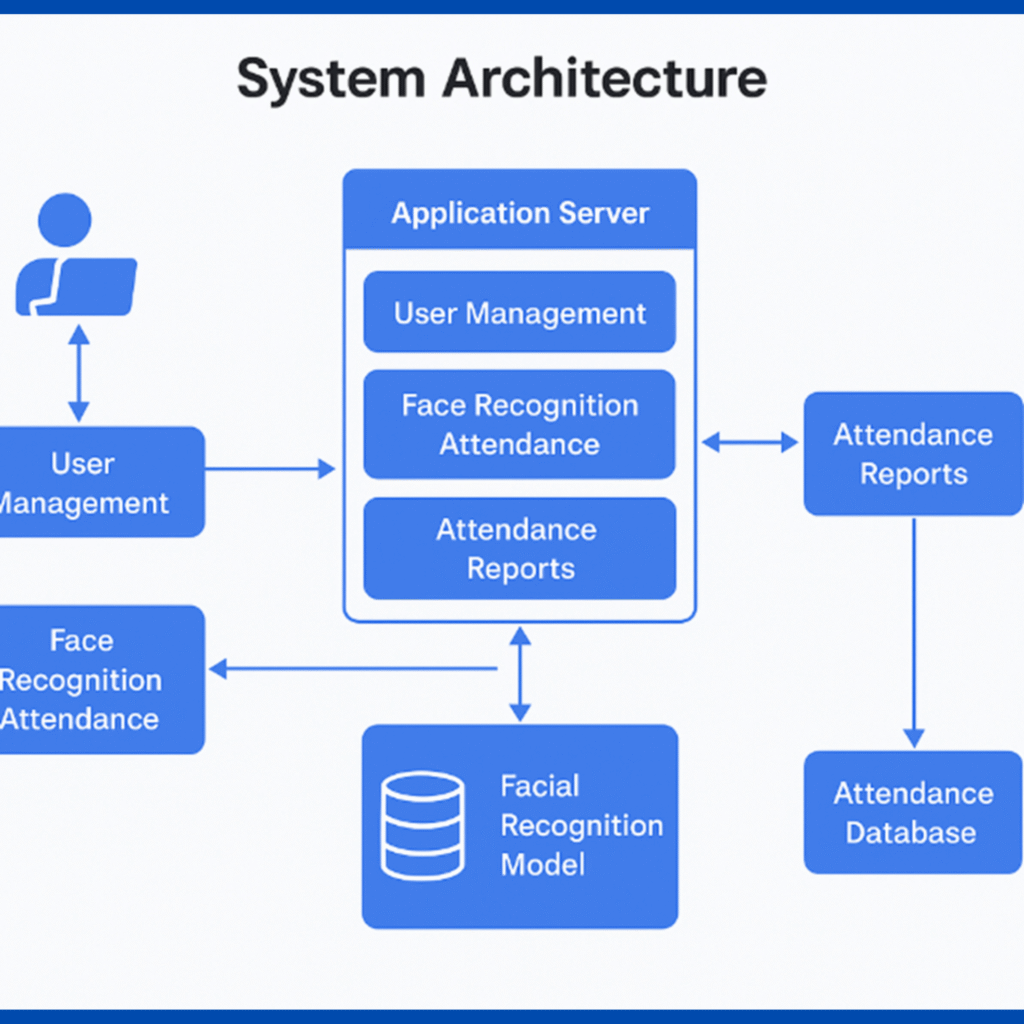
The Smart Campus Management System follows a three-tier architecture:
- Presentation Layer: User interface using HTML, CSS, JavaScript
- Application Layer: Business logic implemented in Python Flask
- Data Layer: MySQL database with optimized query handling
Security is enforced using role-based access control, encrypted data storage, secure session management, and audit logging. Modular design ensures flexibility and seamless integration with external services.
Conclusion
The Smart Campus Management System demonstrates how digital transformation can significantly enhance campus operations in Indian educational institutions. By integrating attendance management, academic scheduling, library services, communication, and infrastructure monitoring into a single platform, the system eliminates inefficiencies associated with traditional methods.
The adoption of the Smart Campus Management System leads to improved data accuracy, faster communication, reduced administrative workload, and enhanced stakeholder satisfaction. Its scalable and secure architecture ensures long-term adaptability, making it a practical and future-ready solution for modern colleges.
Is a Smart Campus Management System suitable for Indian colleges?
Yes, it is designed to handle large student populations and complex administrative workflows common in Indian institutions.
Does the system support biometric attendance?
Yes, the Smart Campus Management System integrates face recognition for secure attendance tracking.
Can parents access student data in real time?
Parents receive instant notifications and real-time academic updates through the parent portal.
Is IoT used in campus management?
Yes, IoT sensors are used for infrastructure monitoring and predictive maintenance.
Is the system scalable for large campuses?
The modular architecture supports scalability and multi-campus expansion.