Table of Contents
Introduction
A Smart Attendance System is a modern, technology-driven solution designed to automate and optimize attendance management in educational institutions. Unlike traditional manual methods, it leverages web technologies and camera-based presence detection to ensure accurate, secure, and real-time attendance recording.
In Indian colleges, faculty members often lose valuable teaching time due to roll calls and manual record maintenance. A Smart Attendance System eliminates these inefficiencies by automating attendance capture, minimizing errors, and preventing proxy attendance. By centralizing attendance data, it enhances transparency, accountability, and accessibility for administrators, faculty, and students.
The Smart Attendance System is built on a role-based architecture that serves three primary stakeholders—administrators, faculty members, and students. Each role within the Smart Attendance System is assigned specific permissions, ensuring secure access and smooth academic operations.
Core Technology
Web Framework and Database Design
The Smart Attendance Systems is developed using the Flask web framework integrated with a MySQL database to ensure scalability and data integrity. Flask provides lightweight yet powerful backend support, making the Smart Attendance System suitable for institutions with large student populations.
Real-time task scheduling in the Smart Attendance Systems is managed using APScheduler, while SMTP protocols enable automated email notifications. Camera integration forms the foundation of the Smart Attendance System, allowing continuous monitoring without manual intervention.
Comprehensive Feature Set
It offers a comprehensive feature set that supports academic and administrative workflows:
- Automated timetable creation and scheduling
- Camera-based attendance recording
- Real-time attendance analytics and reporting
- Digital hall ticket generation
- Course and faculty management modules
- Responsive web access across devices
- Automated email alerts and reminders
These features make the Smart Attendance System an all-in-one attendance management platform for colleges.
Problem Statement
Limitations of Manual Attendance
Manual attendance systems consume class time, introduce human errors, and allow proxy attendance. A Smart Attendance System resolves these challenges by replacing manual inputs with automated verification.
Data and Administrative Challenges
Traditional systems store attendance records across multiple formats, delaying reporting and analysis. The Smart Attendance System centralizes all data, enabling real-time insights and compliance reporting.
Technological Constraints
Existing biometric systems are expensive and unhygienic. A Smart Attendance System removes hardware dependency while remaining scalable and cost-effective.
Existing Attendance Management Systems
Conventional Approaches
- Paper registers with no central database
- Spreadsheet-based tracking with limited automation
- Biometric devices with high maintenance costs
These methods lack the accuracy and scalability provided by a Smart Attendance System.
Proposed System
System Overview
The proposed Smart Attendance System introduces camera-based automation for identifying student presence in classrooms. Attendance is recorded automatically as students enter or exit, ensuring accuracy and real-time updates.
Innovative Capabilities
- Multi-tier Flask architecture
- Role-based access control
- Predictive attendance analytics
- Digital examination hall ticket automation
The Smart Attendance System significantly reduces manual workload and operational costs.
Objectives
Primary Objectives
The Smart Attendance System aims to fully automate attendance processes, improve accuracy, and provide transparent access to all stakeholders.
Technical Objectives
- Scalable architecture supporting 10,000+ users
- Secure data encryption and audit logs
- Real-time camera feed processing
Functional Objectives
The Smart Attendance System empowers administrators with centralized dashboards, faculty with analytics tools, and students with self-service portals.
Featured Snippet: What Is a Smart Attendance System?
A Smart Attendance System is an automated platform that uses cameras, web applications, and databases to record student attendance accurately without manual input, ensuring efficiency, transparency, and compliance in educational institutions.
Software and Hardware Requirements
Software Requirements
The Smart Attendance System supports Linux, Windows, and macOS environments. It requires Python 3.8+, Flask 2.3, and MySQL 8.0 for optimal performance.
Hardware Requirements
High-resolution IP cameras, GPU-enabled servers, and reliable network infrastructure ensure uninterrupted operation of the Smart Attendance System.
System Design and Architecture
Overall Architecture
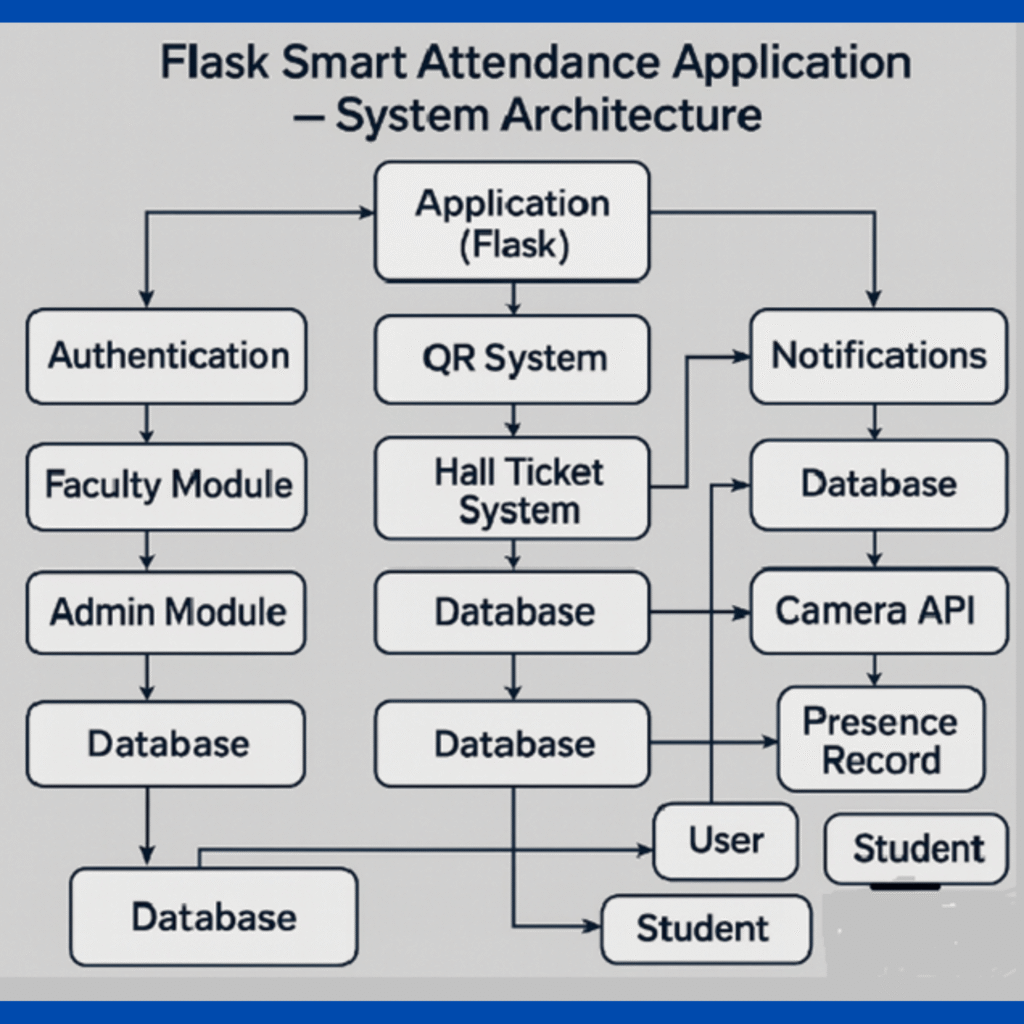
The proposed solution is structured using a multi-tier architectural model that separates responsibilities across three layers: the presentation layer, the application layer, and the data layer. This separation ensures improved scalability, maintainability, and security. Communication between system modules is handled through RESTful APIs, allowing seamless integration and efficient data exchange across components.
Database Design and Data Flow
Attendance information is captured through camera-based detection mechanisms and then passed through a validation process before being securely stored in the database. This structured data flow enables real-time updates, supporting live dashboards and analytical tools that assist academic and administrative decision-making.
Advantages of the System
Operational Benefits
The automated approach significantly reduces the workload of teaching staff by minimizing manual tasks. Faculty members experience up to a 90% reduction in time spent on attendance-related activities. Administrative processes such as reporting and scheduling are fully automated, leading to faster execution and lower operational costs for institutions.
Accuracy and Security
High levels of accuracy are achieved through automated presence verification, effectively eliminating errors and fraudulent practices such as proxy attendance. Secure authentication mechanisms and controlled access further ensure the integrity and confidentiality of attendance records.
Scalability
The system is designed to scale effortlessly, making it suitable for deployment in small colleges as well as large universities. Its flexible architecture allows institutions to expand functionality and user capacity without compromising performance.
Applications
Educational Institutions
The solution is applicable across a wide range of academic environments, including universities, colleges, schools, and professional training centers. It supports diverse academic structures and varying attendance policies.
Administrative Use
From an administrative perspective, the system simplifies regulatory compliance, optimizes faculty workload allocation, and supports data-driven institutional planning. Centralized access to attendance insights enhances operational transparency and efficiency.
Conclusion
This technology-driven attendance solution marks a significant advancement in academic management for Indian educational institutions. By integrating camera-based automation with secure web technologies and real-time analytics, it effectively removes the limitations of manual attendance processes while improving accuracy and transparency.
In addition to saving time for faculty and administrators, the system empowers students by providing instant visibility into attendance records. Its reliability, adaptability, and future-ready design align well with India’s ongoing digital education initiatives, making it a sustainable and impactful solution for modern campuses.
What is a Smart Attendance Systems?
It automates attendance using cameras and web technology.
Is Smart Attendance Systems suitable for Indian colleges?
Yes, it is designed for large student populations and regulatory compliance.
Does the Smart Attendance System prevent proxy attendance?
Yes, automated detection eliminates proxy attendance completely.
Is biometric hardware required?
No, the Smart System uses camera-based automation.
Can students view their attendance?
Yes, students can access attendance records in real time.