Table of Contents
Introduction to the Digital Prescription System
India’s healthcare landscape is undergoing rapid digital transformation, yet many hospitals, clinics, and pharmacies still rely on handwritten or paper-based prescriptions. These conventional methods create multiple risks, including misplaced records, illegible handwriting, unauthorized alterations, and fragmented medical histories. For students studying health informatics, computer science, or biomedical engineering, understanding how technology can modernize prescription management is both academically and socially significant.
A Digital Prescription System offers a structured, secure, and centralized alternative to paper records. Instead of physical slips, doctors generate verifiable electronic prescriptions that are stored in a protected cloud-based or server-based repository. Patients can access their medical records anytime, while pharmacists can retrieve prescriptions only after proper identity verification. This shift reduces medical errors, improves traceability, and strengthens trust between healthcare stakeholders.
Beyond convenience, the Digital Prescription System introduces cryptographic safeguards such as SHA-256 hashing to ensure file integrity. Every uploaded prescription receives a unique digital fingerprint that changes if even a single character is modified. Combined with OTP-based authentication, this system builds a secure e-prescription ecosystem tailored for Indian healthcare needs.
For college students developing capstone projects, this model provides an excellent example of how software engineering, cybersecurity, and healthcare workflows can converge into a real-world solution that enhances patient safety and operational efficiency.
Purpose and Value of the Digital Prescription System
The core purpose of the Digital Prescription System is to eliminate inefficiencies and security vulnerabilities associated with paper prescriptions. From a technological standpoint, the platform integrates authentication, encryption, and role-based access control into a single cohesive framework.
One major advantage of this Digital Prescription System is enhanced security. Traditional prescriptions can be easily forged, altered, or duplicated, leading to misuse of medications. By embedding cryptographic signatures, the system ensures that any tampering is immediately detectable.
Another critical benefit is controlled access. Instead of allowing unrestricted viewing of medical records, the platform uses two-factor authentication (2FA) via OTP to confirm identity before granting access. This protects sensitive patient data while maintaining usability.
From an operational perspective, the Digital Prescription System streamlines the entire lifecycle of medical prescriptions—from issuance by doctors to validation by pharmacists. This reduces waiting time, minimizes paperwork, and improves overall healthcare efficiency.
For patients, the system provides lifelong digital access to their medical history. Instead of carrying multiple files across hospitals, they can store everything in one centralized and secure platform, making continuity of care significantly easier.
Scope, Features, and Limitations
The Digital Prescription System is designed as a tri-party web application with distinct modules for patients, doctors, and pharmacists. Each user type receives a customized dashboard aligned with their responsibilities.
Patients can register using Aadhaar, manage their profiles, link trusted doctors, and review past prescriptions. Doctors can search for patients, verify identity via OTP, and upload prescriptions using file uploads or webcam capture. Pharmacists can retrieve patient prescriptions only after receiving OTP consent.
A key technical feature of the Digital Prescription System is automated SHA-256 hashing. Every prescription receives a unique digital signature stored in the database, enabling instant integrity checks.
However, the system has some limitations. It does not yet integrate with government initiatives such as the Ayushman Bharat Digital Mission (ABDM). It also lacks pharmacy inventory management, billing modules, or real-time telemedicine features. Despite these constraints, it serves as a strong foundational prototype.
Core Concepts in Secure E-Prescriptions
Digital Signature and File Integrity
In this Digital Prescription System, a digital signature does not mean a handwritten signature scanned into a computer. Instead, it refers to a cryptographic hash generated using SHA-256. This hash acts like a fingerprint of the prescription file.
If even one character is changed, the hash value will be completely different, signaling potential tampering. This ensures that pharmacists and patients can trust the authenticity of prescriptions issued through the Digital Prescription System.
Such integrity mechanisms are crucial in preventing fraud, counterfeit prescriptions, and unauthorized modifications, making the system academically robust and industry-relevant.
OTP Authentication and Aadhaar Integration
The Digital Prescription System relies on OTP-based two-factor authentication for secure access. When a doctor or pharmacist attempts to view patient data, an OTP is sent to the patient’s registered mobile number or email.
Aadhaar serves as the primary identifier for patients, ensuring unique identification across the platform. This aligns well with India’s digital identity ecosystem while maintaining privacy safeguards.
Problems in Traditional Prescription Systems
Key Challenges in Paper-Based Prescriptions
Traditional prescription systems suffer from multiple structural weaknesses. Handwritten prescriptions can be misread, leading to incorrect medication. Physical documents can be lost, damaged, or altered.
Moreover, there is no reliable way to verify authenticity. Anyone can potentially forge a prescription, putting patients at risk. The Digital Prescription System eliminates these issues through secure verification.
Formal Problem Statement
The objective is to design a secure, centralized Digital Prescription System that prevents fraud, ensures data integrity through cryptographic hashing, and enforces OTP-based access control for all stakeholders.
Goals and Objectives
Project Goals
The Digital Prescription System aims to digitize and centralize prescription records, replacing fragmented paper systems with a unified digital repository.
It also establishes a secure healthcare network where access is strictly controlled, ensuring patient privacy and accountability among doctors and pharmacists.
Measurable Objectives
Key objectives include building a multi-role platform, implementing OTP authentication, enabling secure prescription uploads, and generating SHA-256 digital signatures for every record in the Digital Prescription System.
System Requirements
Hardware Requirements
The Digital Prescription System can run on standard laptops during development but requires a dedicated cloud server for production deployment.
Software Requirements
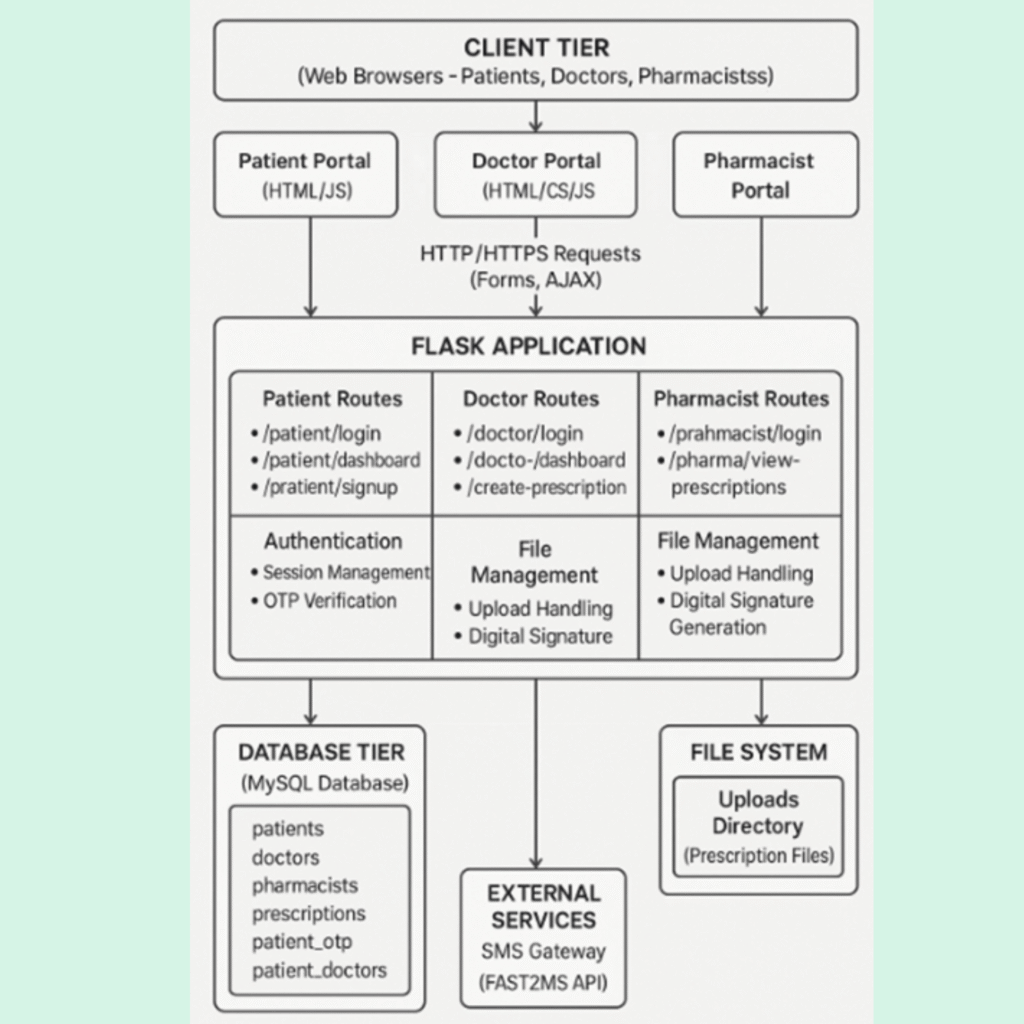
The system is built using Flask, Python, MySQL, HTML, CSS, JavaScript, and Bootstrap, making it lightweight yet scalable.
Functional Requirements
Patients can register, view prescriptions, and manage doctors. Doctors can upload prescriptions securely. Pharmacists can access records only after OTP verification.
Non-Functional Requirements
Security, performance, usability, reliability, and scalability are central to the Digital Prescription System’s architecture.
System Design and Workflows
System Architecture
The Digital Prescription System follows a three-tier architecture: client (browser), server (Flask backend), and database (MySQL).
Input and Output Design
Users interact through structured web forms. Outputs include dashboards, prescription histories, and integrity verification results.
Doctor Workflow
A doctor logs in, verifies the patient via OTP, uploads a prescription, and the system automatically generates a digital signature.
Pharmacist Workflow
A pharmacist requests access, receives patient consent via OTP, and verifies the prescription’s integrity before dispensing medicine.
Conclusion
The Digital Prescription System successfully demonstrates how secure, web-based healthcare technology can modernize prescription management in India. By integrating OTP authentication and SHA-256 hashing, the platform ensures trust, transparency, and accountability.
Although currently a prototype, the system lays a strong foundation for future enhancements such as mobile apps, AI analytics, and integration with national digital health initiatives.
What is a Digital Prescription System?
A Digital Prescription System is a secure web-based platform that allows doctors to create electronic prescriptions, patients to store and access them, and pharmacists to verify and dispense medicines safely.
How a Digital Prescription System Works (Step-by-Step)
Patient Registration: The patient signs up using Aadhaar, mobile number, and email.
Doctor Linking: The patient selects trusted doctors on the platform.
Prescription Creation: The doctor uploads or captures a prescription image.
Digital Signing: The system applies SHA-256 hashing for integrity protection.
OTP Verification: Pharmacists request access, and patients approve via OTP.
Secure Access: Only verified pharmacists can view and dispense medicines.
This structured workflow makes the Digital Prescription System reliable, transparent, and legally auditable.
How does OTP verification work?
An OTP is sent to the patient’s phone/email before access is granted.
Is SHA-256 secure?
Yes, it is a widely trusted cryptographic algorithm.
Can pharmacists access records freely?
No, only after patient OTP approval.
Does this integrate with ABDM?
Not currently, but it can be extended in the future.
Is this suitable for final-year projects?
Yes, it is highly relevant for engineering and IT students.