

Table of Contents
Abstract
Blockchain Smart Contract–based digital certificate systems are becoming increasingly important as nearly one million students graduate annually according to the Taiwan Ministry of Education, with many pursuing higher education or entering the workforce. Academic credentials such as transcripts, diplomas, and merit certificates play a vital role in admissions and employment decisions; however, traditional certificate issuance relies heavily on manual data entry and centralized storage, offering limited protection against forgery. As a result, fraudulent graduation certificates are frequently reported.
To address this issue, a secure digital certificate verification framework using Blockchain Smart Contract technology is proposed. By leveraging the immutability and decentralization of blockchain technology (IBM Blockchain), the Blockchain Smart Contract ensures tamper-proof storage and transparent verification of academic credentials.
In this system, an electronic version of the physical certificate is generated along with relevant metadata, and a cryptographic hash of the certificate file is computed. This hash value is permanently recorded on the blockchain through a Blockchain Smart Contract, guaranteeing data integrity and non-repudiation. Additionally, a QR code and unique query string are generated and affixed to the physical certificate, enabling institutions and employers to instantly verify authenticity through mobile scanning or web-based queries supported by smart contract execution on blockchain platforms such as Ethereum.
Introduction
Blockchain Smart Contract–driven advancements in information technology, widespread Internet access, and the growing use of mobile devices have significantly transformed modern lifestyles. Digital assets and virtual currencies, originally intended for online transactions, are now increasingly adopted in real-world applications. Popular cryptocurrencies such as Bitcoin, Ether, and Ripple have gained massive attention due to their rapid growth in value, leading to heightened interest in the underlying blockchain technology.
At the core of these innovations, Blockchain Smart Contract systems rely on a decentralized and tamper-resistant database architecture that offers immense potential across multiple domains. Blockchain operates as a distributed ledger used to record transactions securely; once consensus is achieved among participating nodes, verified transactions are grouped into blocks and permanently added to the chain. Each block contains the cryptographic hash of its predecessor, ensuring data integrity and traceability.
Since data are distributed across multiple nodes, no single authority controls the database, enhancing transparency and resilience. A block is considered valid only after verification by multiple parties, making unauthorized modification practically impossible. In this context, Blockchain Smart Contract technology enables automated and trustworthy execution of predefined rules, eliminating reliance on intermediaries and ensuring data authenticity. Such capabilities have positioned Blockchain Smart Contract–based systems as reliable solutions for secure digital record management, as highlighted by enterprise blockchain platforms like IBM Blockchain and smart contract ecosystems such as Ethereum.
Problem statement
Blockchain Smart Contract – based certificate management is increasingly important due to the rapid growth of information technology and the rising need for strong data protection mechanisms. In today’s digital environment, safeguarding sensitive academic records has become a critical concern for both individuals and institutions.
Graduates who plan to pursue higher education or enter the workforce are required to submit multiple academic and achievement certificates during admissions and recruitment processes. These documents play a vital role in verifying a candidate’s qualifications and credibility.
However, physical certificates are often lost, misplaced, or damaged over time. Reapplying for hard copies is usually a lengthy process, as certificates are issued by different authorities and may require in-person verification and manual procedures.
Digital certificates provide a convenient and paperless alternative, allowing graduates to request electronic copies by completing identity verification. While this approach saves time and resources, it also introduces new security challenges.
Due to the ease of generating digital documents, forged degrees, licenses, and certificates have become increasingly common. As a result, educational institutions and employers face difficulties in instantly validating the authenticity of submitted credentials.
To overcome these challenges, this study proposes a secure digital certificate issuance and verification system using Blockchain Smart Contract technology. By ensuring immutability, transparency, and automated validation, the Blockchain Smart Contract helps prevent forgery and enables reliable, real-time verification of academic certificates.
Objectives
1. Counterfeit Prevention
The primary objective of this project is to prevent certificate counterfeiting by implementing a secure issuance and verification framework using Blockchain Smart Contract technology. The immutable nature of blockchain ensures that issued certificates cannot be altered or duplicated fraudulently.
2. Verification Efficiency
The system aims to enable fast and reliable verification of certificate authenticity for employers, educational institutions, and other stakeholders. Through Blockchain Smart Contract–based validation, certificates can be verified instantly using QR code scanning or web-based queries.
3. Data Integrity
Ensuring the integrity and security of certificate data is a key objective. By recording certificate hashes on an unmodifiable blockchain ledger, the Blockchain Smart Contract prevents unauthorized changes and preserves the originality of issued credentials.
4. Cost Reduction
Another objective is to reduce the operational and administrative costs associated with traditional certificate verification. Automating verification through Blockchain Smart Contract execution minimizes manual intervention and streamlines the overall process.
5. Enhanced Trust
The project seeks to build trust among graduates, employers, and educational institutions by providing a transparent and tamper-proof certificate system. The use of Blockchain Smart Contract technology ensures that all verifications are reliable and auditable.
6. Accessibility
The system is designed to be accessible to users with varying levels of technical expertise. User-friendly interfaces supported by Blockchain Smart Contract verification allow easy access through mobile devices and web platforms.
7. Scalability
Scalability is a crucial objective, ensuring that the system can handle a large number of certificates and verification requests. The Blockchain Smart Contract architecture supports expansion to accommodate the growing number of graduates each year.
8. Compliance
The project also focuses on maintaining compliance with applicable regulations and standards related to data privacy and security. Blockchain Smart Contract mechanisms help enforce predefined rules and access controls consistently.
9. User Education
Providing guidance and educational resources is an important objective to promote adoption. Training and documentation help issuing authorities, graduates, and verifying parties understand how to interact with the Blockchain Smart Contract–based system.
10. Feedback Mechanism
Finally, the system incorporates a feedback mechanism to collect user input and continuously improve performance, usability, and security. Insights gathered will help refine the Blockchain Smart Contract implementation over time.
Existing System and Its Disadvantages
Blockchain Smart Contract–based solutions are absent in the current paper-based certificate issuance and verification system, resulting in multiple limitations. Traditional physical certificates are highly vulnerable to forgery, as altering or replicating paper documents is relatively easy, leading to fraud and misuse.
The verification process in the existing system is largely manual, making it time-consuming and labor-intensive. This approach lacks transparency and traceability, as verifying authorities must rely on physical inspection and manual record checks.
Paper certificates are also prone to loss, damage, or unauthorized modification, which compromises data integrity and long-term reliability. Once damaged or misplaced, reissuing certificates involves significant administrative effort.
Limited accessibility further reduces efficiency, as physical presence or direct communication with issuing authorities is often required. Additionally, high operational costs associated with printing, storage, and verification place a financial burden on institutions and organizations.
Security risks such as theft and unauthorized access, along with environmental concerns due to excessive paper usage, highlight the urgent need for a more secure, efficient, and sustainable alternative.
Proposed System and Its Advantages
Blockchain Smart Contract–enabled digital certificate systems are proposed to overcome the limitations of traditional methods. By utilizing the immutability and decentralization of blockchain technology, the system ensures a high level of security and trust in certificate authenticity.
Digital certificates issued through a Blockchain Smart Contract are tamper-proof, as any unauthorized alteration is immediately detectable. This guarantees data integrity and eliminates the possibility of counterfeit certificates.
The verification process is fast and efficient, allowing stakeholders to confirm certificate validity through QR code scanning or web-based verification. Automation through Blockchain Smart Contract execution significantly reduces manual effort and verification time.
Operational costs are minimized by eliminating paper-based processes and reducing administrative workload. The system also contributes to environmental sustainability by removing the need for physical certificate production and storage.
Furthermore, the proposed system enhances accessibility and convenience, enabling remote verification from anywhere at any time. Overall, the Blockchain Smart Contract–based approach provides a secure, efficient, and scalable solution for modern digital certificate issuance and verification.
About Project
Project Description
Blockchain Smart Contract–based digital certificate systems are proposed in this project to address the growing problem of certificate forgery. With nearly one million graduates each year in Taiwan, the existing paper-based certificate issuance framework lacks strong anti-forgery mechanisms, resulting in increased cases of fraudulent academic credentials.
The proposed solution utilizes Blockchain Smart Contract technology to create secure, tamper-proof, and verifiable digital certificates. By leveraging the unmodifiable and decentralized nature of blockchain, the system ensures that once a certificate is issued, its authenticity cannot be altered or manipulated.
In this system, electronic versions of certificates are generated and processed to calculate cryptographic hash values. These hash values are permanently recorded on the blockchain through a Blockchain Smart Contract, ensuring data integrity and non-repudiation.
To simplify verification, the system generates QR codes and unique inquiry string codes that are embedded within physical or digital certificates. Employers, institutions, and other verifying authorities can authenticate certificates instantly using mobile devices or web-based verification portals powered by Blockchain Smart Contract validation logic.
Beyond technical benefits, the system enhances trust and credibility in academic certifications while reducing administrative effort and operational costs. It also offers global accessibility, efficient verification, and improved privacy control for users. The project design is informed by insights from existing literature, incorporating proven advantages while addressing known challenges in blockchain-based credential systems.
The societal impact of the proposed solution includes reduced certificate fraud, increased trust in educational institutions, improved verification efficiency, global recognition of academic qualifications, and stronger user control over personal data.
Proposed Design
The proposed design focuses on integrating Blockchain Smart Contract technology with a user-friendly digital certificate management platform. The system is structured to ensure secure certificate issuance, storage, and verification while maintaining scalability and compliance with data protection standards.
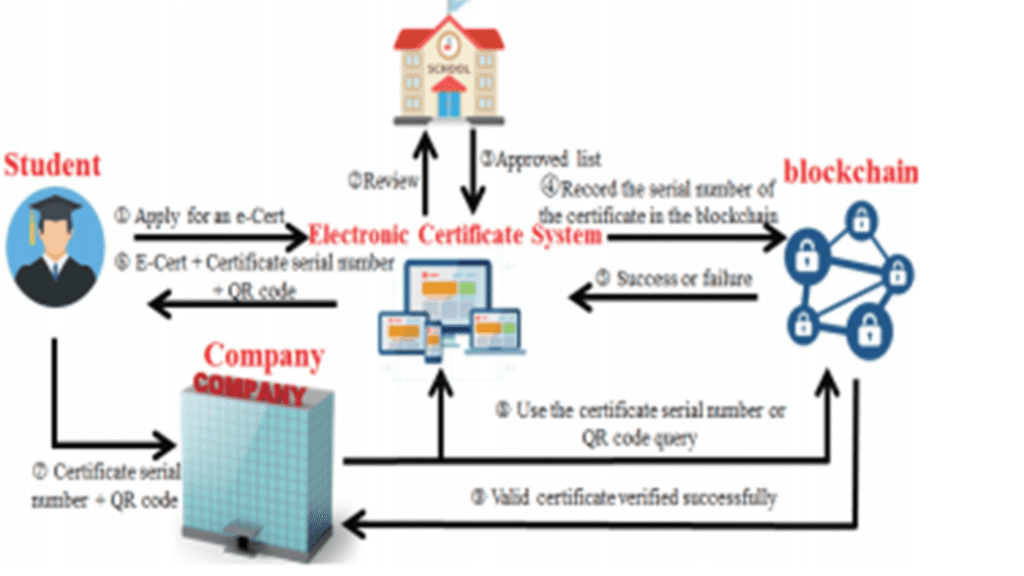
Architecture of the Project
REQUIREMENTS
Functional Requirement Analysis
Blockchain Smart Contract–based systems require clearly defined functional requirements to ensure secure and efficient digital certificate issuance and verification.
1. User Registration and Authentication
The system shall allow users such as educational institutions, employers, and students to register on the platform. Secure authentication mechanisms must be implemented to verify user identities and prevent unauthorized access using Blockchain Smart Contract–enabled validation.
2. Certificate Issuance
Authorized entities, particularly educational institutions, shall be able to issue digital certificates through the system. The Blockchain Smart Contract must support the entry of student and institutional details, generate an electronic version of the certificate, and store relevant data securely in the database.
3. Hash Calculation
The system shall compute a cryptographic hash value for each electronic certificate file. This unique hash ensures data integrity and is permanently associated with the certificate through the Blockchain Smart Contract.
4. Blockchain Integration
The system must integrate seamlessly with a blockchain network to store certificate-related data. Hash values and metadata shall be recorded in blockchain blocks using Blockchain Smart Contract logic to guarantee immutability and security.
5. QR Code and Inquiry String Generation
For every issued digital certificate, the system shall generate a unique QR code and inquiry string. These identifiers will be embedded in the certificate to facilitate quick and reliable verification via the Blockchain Smart Contract.
6. Certificate Verification
Employers, institutions, or any authorized users shall be able to verify certificates by scanning the QR code or entering the inquiry string. The system shall validate certificate authenticity by cross-referencing blockchain-stored data using Blockchain Smart Contract execution.
7. Smart Contracts for Certificate Verification
Smart contracts shall be implemented to automate the verification process. The Blockchain Smart Contract will instantly validate certificates and return verification results without manual intervention.
8. User Notifications
The system shall notify certificate holders when a new certificate is issued or verified. Issuing institutions shall also receive alerts whenever certificates are accessed, ensuring transparency through Blockchain Smart Contract–driven events.
9. Security Measures
Robust security mechanisms, including encryption, role-based access control, and secure key management, shall be enforced. The Blockchain Smart Contract ensures controlled access to certificate data and prevents unauthorized modifications.
10. Compliance with Regulations
The system shall comply with relevant data protection and privacy regulations. Blockchain Smart Contract rules will enforce compliance by restricting access and ensuring lawful data handling.
11. Scalability and Performance
The system shall be designed to handle large volumes of certificate issuance and verification requests efficiently. The Blockchain Smart Contract architecture must support scalability without performance degradation.
12. Backup and Recovery
Backup and recovery mechanisms shall be implemented to prevent data loss. Off-chain storage and blockchain redundancy ensure data availability and reliability alongside the Blockchain Smart Contract.
Hardware Requirements
- Processor: Intel i3
- RAM: 8 GB
- Hard Disk: 160 GB
Software Requirements
- Operating System: Windows 10
- JDK: Version 1.8
- IDE: NetBeans, Android Studio, Jupyter Notebook
- Programming Languages: Java, Android, Python, Solidity
METHODOLOGY
The proposed system leverages Blockchain Smart Contract technology to ensure secure, tamper-proof issuance and verification of digital certificates. The methodology involves converting paper certificates into electronic files, calculating their unique hash values, and storing these hashes on the blockchain to guarantee data integrity. A QR code and inquiry string are generated for each certificate, allowing authorized parties to verify authenticity through mobile scanning or web-based queries. By utilizing the unmodifiable and decentralized properties of blockchain, the system enhances the credibility of traditional paper-based certificates.
Working Process of the System
- Certificate Issuance by Schools
Schools issue a degree or achievement certificate and enter the student’s details into the system. The system automatically records the student’s serial number and certificate data on the blockchain using a Blockchain Smart Contract. - Data Verification
The system verifies all entered data to ensure accuracy and completeness before issuing the certificate electronically. - E-Certificate Generation
Instead of sending conventional hard copies, the system issues e-certificates containing a QR code to the verified graduate. Each graduate also receives a unique inquiry number and an electronic copy of the certificate. - Verification by Employers or Institutions
Graduates can share their QR-coded e-certificate or serial number when applying for jobs or further studies. Companies or institutions query the system to check the validity of the certificate. - Validation Feedback
The QR code allows employers to detect any tampering or forgery, and the blockchain provides instant confirmation of certificate authenticity through the Blockchain Smart Contract.
Advantages of the Proposed System
- Decentralized Verification: Information is verified by a network of computers, eliminating the need for manual verification and reducing administrative overhead.
- Immutable Records: Every action is permanently recorded on the blockchain. Data cannot be altered or deleted, ensuring transparency and reliability for all participants.
- Efficient and Secure: Automated verification via Blockchain Smart Contract reduces processing time and strengthens trust in the certificate issuance process.
Conclusion
Blockchain Smart Contract–based digital certificate systems provide a robust solution for ensuring data security and authenticity in certificate management. Blockchain functions as a decentralized and shared ledger where every participating node stores and verifies identical data, eliminating single points of failure and enhancing trust.
By implementing the proposed Blockchain Smart Contract–enabled system, the risk of certificate forgery is significantly reduced. The immutable nature of blockchain ensures that once certificate data is recorded, it cannot be altered or manipulated without detection.
The processes of certificate application, issuance, and automated verification are transparent and traceable within the system. Organizations and employers can easily query and verify certificate information without relying on intermediaries, improving efficiency and reliability.
In conclusion, the proposed Blockchain Smart Contract–based solution guarantees data integrity, accuracy, and security while offering a transparent and efficient approach to digital certificate issuance and verification.
