
Table of Contents
Abstract
ML Projects for Final Year often focus on solving socially impactful challenges using artificial intelligence and computer vision. One of the most powerful examples is Sign Language Recognition (SLR) — a system that interprets gestures made by deaf and mute individuals to facilitate communication with the hearing world.
In this paper, we propose an innovative approach that integrates algorithms such as Support Vector Machine (SVM), K-Neighbors Classifier, Logistic Regression, MLP Classifier, Naive Bayes, and Random Forest Classifier. These models help in detecting and classifying hand gestures efficiently using image processing. Such innovative ideas are among the most impactful ML Projects for Final Year, bridging the gap between artificial intelligence and human accessibility.
For a deeper understanding of AI fundamentals, students can explore Google AI Education, Kaggle Datasets, and Scikit-learn Documentation to enhance their project accuracy and research skills.
Introduction
ML Projects for Final Year in image processing and gesture recognition have revolutionized human-computer interaction. Image processing is a fast-growing field with applications in biometrics, healthcare, remote sensing, and pattern recognition. It focuses on how a computer senses, analyzes, and understands visual data.
Gesture-based interfaces allow humans to communicate naturally with machines — for example, pointing gestures can command robots or select objects in virtual environments. This concept has immense potential to help differently-abled people interact with technology seamlessly.
By combining machine learning and image recognition, we can build systems that understand sign gestures and translate them into meaningful outputs. Students aiming to explore similar topics in ML Projects for Final Year can refer to OpenCV Documentation for image preprocessing techniques and TensorFlow Tutorials for implementing neural network-based models for gesture classification.
Problem Statement
The existing systems for Sign Language Recognition require users to be physically in front of the computer to communicate, limiting convenience. People with hearing or speech impairments face daily communication barriers, making this an area of critical importance.
ML Projects for Final Year that focus on sign language interpretation aim to eliminate these barriers through real-time hand gesture recognition. With advancements in computer vision and deep learning, this project provides a powerful way to translate visual gestures into meaningful text or speech.
Students can also explore research papers on IEEE Xplore to understand prior models and performance metrics for gesture recognition systems.
Aim and Objective
The primary goal of this project is to design a Machine Learning-based Sign Language Recognition System that enables easier communication for deaf and mute individuals.
The objectives are:
- To capture and recognize hand gestures through image processing.
- To classify gestures using machine learning algorithms for accurate translation.
- To improve inclusivity through AI-driven interfaces.
This type of project represents one of the most meaningful ML Projects for Final Year, merging artificial intelligence, human-computer interaction, and social welfare.
Students can use platforms like Google Colab or Jupyter Notebook to build and train their ML models efficiently in real-time environments.
System Requirements Specification (SRS)
A Software Requirement Specification (SRS) is essential in defining the scope, objectives, and system functionalities. It serves as a roadmap for project development and ensures clarity between clients and developers.
The SRS plays a vital role in reducing development errors and maintaining consistency across the project lifecycle. For ML Projects for Final Year, a well-documented SRS defines project datasets, algorithms, evaluation metrics, and performance benchmarks.
Hardware Requirements:
Processor: Any processor above 500 MHz
RAM: Minimum 2 GB
Hard Disk: 80 GB or more
Software Requirements:
Operating System: Windows 7/8/10
IDE: Python (via Anaconda Navigator)
Programming Language: Python
For guidance on writing effective SRS documents, students can refer to IEEE SRS Standards and examples from ResearchGate.
System Architecture
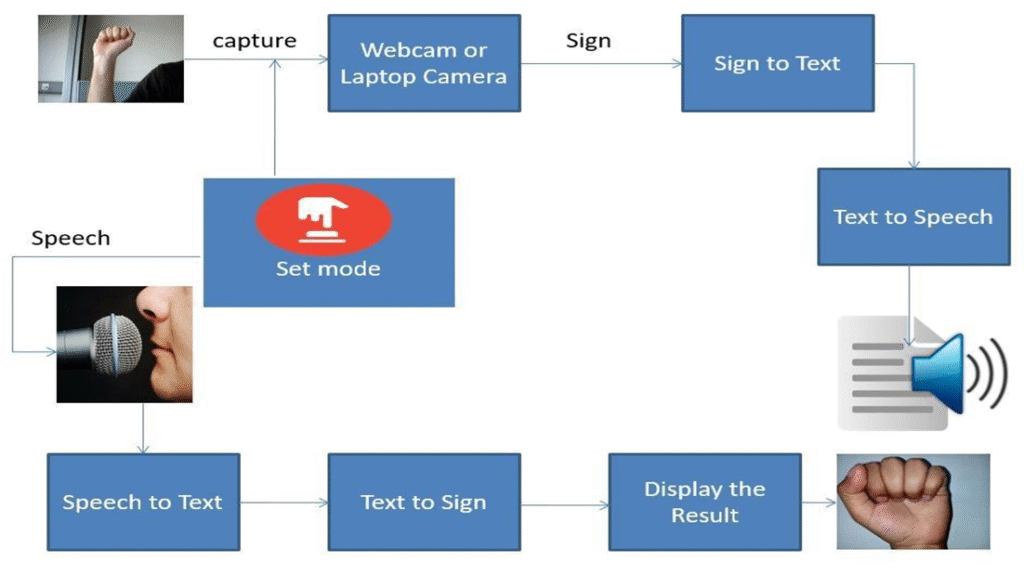
The system architecture defines the framework and communication flow between various components. It begins by identifying subsystems and establishing communication among them. The goal is to ensure efficient data flow between image capture, preprocessing, feature extraction, classification, and result analysis modules.
This architecture is crucial for students developing ML Projects for Final Year, ensuring modularity, scalability, and easier debugging during implementation.
Modules
The proposed system consists of five major modules that work together to interpret and classify hand gestures:
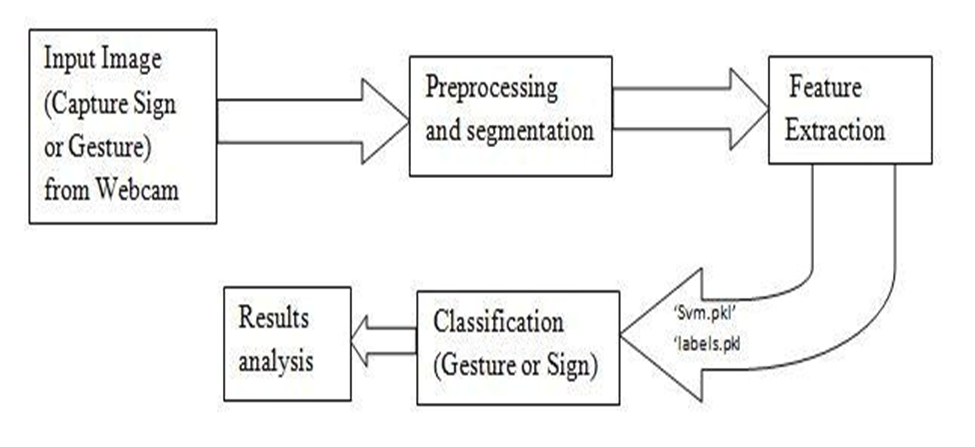
Input Image (Capture Gesture):
The gesture is captured via a webcam or external camera for better clarity and image resolution.
Preprocessing and Segmentation:
Converts RGB images into HSV color space for better illumination control. Filtering and smoothing techniques remove noise, focusing only on hand regions.
Learn more about image preprocessing at OpenCV Tutorials.
Feature Extraction:
Extracts distinctive gesture features from the image. These are stored in datasets like svm.pkl and labels.pkl for training and testing.
For ML feature extraction examples, visit Scikit-learn Feature Extraction Guide
Classification:
Uses trained models (SVM, KNN, Random Forest, etc.) to recognize gestures based on extracted features. This forms the decision-making layer of the model.
Result Analysis:
Evaluates the model’s accuracy. The system achieved approximately 97% accuracy, showcasing the effectiveness of the hybrid classification approach.
Such performance-driven architectures make this one of the most exciting ML Projects for Final Year, combining technical innovation with real-world social impact.


