Table of Contents
Introduction
Infertility has become a pressing medical, social, and psychological concern across India, particularly among young adults and college students. Changing lifestyles, increased stress levels, sedentary behavior, pollution, delayed family planning, and unhealthy dietary patterns have significantly influenced reproductive health. Despite advancements in medical science, access to timely, affordable, and reliable fertility assessment remains a challenge for many individuals, especially in rural and semi-urban regions. An AI infertility prediction system offers a technology-driven solution that supports early screening and risk assessment before invasive clinical procedures.
Traditional fertility evaluation involves multiple laboratory tests, specialist consultations, and imaging procedures, making the process expensive, time-consuming, and emotionally draining. Many students hesitate to seek medical help due to stigma, lack of awareness, or fear of diagnosis. The AI infertility prediction system helps overcome these barriers by providing a confidential, non-invasive, and data-driven assessment through a web-based platform.
By integrating machine learning with healthcare analytics, this system enables early detection of reproductive health risks using structured clinical, hormonal, and lifestyle data. This project bridges the gap between advanced computational intelligence and practical healthcare applications, offering a scalable digital fertility screening tool tailored to Indian students and young adults.
Problem Context and Research Gap
Conventional infertility diagnosis in India relies heavily on hospital-based procedures that require specialized infrastructure and expert interpretation. Patients often undergo repeated tests across multiple cycles, leading to delays in diagnosis and increased financial burden. Rural regions frequently lack fertility specialists, forcing individuals to travel long distances for medical evaluation.
A major limitation of traditional diagnosis is its fragmented approach—male and female infertility are assessed separately rather than within a unified framework. This results in incomplete analysis of reproductive health dynamics between partners. Additionally, manual clinical evaluation struggles to identify subtle correlations within large datasets, especially in complex conditions like PCOS.
The absence of an integrated, intelligent, and automated system capable of predicting infertility for both genders creates a critical gap in modern healthcare. An AI infertility prediction system addresses this need by applying machine learning techniques to analyze diverse biological and lifestyle factors simultaneously.
Need for an Intelligent Prediction Platform
A comprehensive digital screening platform is essential to make fertility assessment more accessible, affordable, and efficient. An AI infertility prediction system can function as a preliminary diagnostic support tool in universities, primary healthcare centers, and telemedicine clinics.
By leveraging data-driven insights, this system reduces dependence on subjective interpretation and ensures consistent evaluation across different users and regions. The project aims to develop a reliable, scalable, and user-friendly infertility prediction platform that supports early intervention and informed medical decision-making.
Objectives of the AI Infertility Prediction System
The primary goal of this research is to design and implement an AI infertility prediction system that assesses reproductive health risks for both males and females using machine learning and deep learning techniques. The key objectives include:
- Developing a neural network model for predicting PCOS in women based on clinical and hormonal data.
- Implementing ensemble learning and decision-tree models for male fertility prediction using lifestyle and semen parameters.
- Integrating both models into a unified Flask-based web application.
- Enabling manual data entry and CSV-based bulk predictions.
- Creating a secure MySQL database to store patient records, predictions, and reports.
- Generating automated PDF reports for clinical documentation.
- Reducing diagnostic delays and improving accessibility to fertility screening.
These objectives collectively aim to modernize reproductive healthcare through automation, precision, and digital innovation.
Scope and Applicability of the System
The AI infertility prediction system includes data preprocessing modules that clean, normalize, and validate user inputs before prediction. The system evaluates female fertility through a neural network trained on PCOS datasets and assesses male fertility using ensemble classifiers and decision trees.
The platform provides a complete web interface for data submission, result visualization, and report downloading. Built using Python, Flask, and MySQL, the system ensures cross-platform compatibility and secure data storage.
Future extensions include mobile app integration, cloud deployment, real-time analytics dashboards, and interoperability with hospital information systems, making the solution suitable for clinics, diagnostic centers, and telemedicine services.
System Requirements and Technical Foundation
The frontend is developed using HTML5, CSS3, Bootstrap 5, and JavaScript to create a responsive and intuitive user interface. Interactive features such as input validation, charts, and dynamic dashboards enhance usability.
The backend utilizes Python and Flask to manage routing, authentication, and model execution. Machine learning libraries including TensorFlow, Keras, and Scikit-learn power the predictive analytics. Data handling is performed using NumPy and Pandas, while model serialization is managed through Pickle and Joblib.
A MySQL database stores user credentials, female PCOS records, male fertility data, and system logs. Secure authentication mechanisms protect sensitive medical information.
Minimum hardware requirements include an Intel i3 processor and 4GB RAM, while 8–16GB RAM is recommended for optimal performance. An SSD is preferred for faster data processing and model loading.
Analysis of Existing Diagnostic Systems
Traditional female infertility diagnosis includes hormonal blood tests, pelvic ultrasound, ovulation tracking, and clinical symptom evaluation. While accurate, these methods are expensive, invasive, and specialist-dependent. Misdiagnosis is possible due to overlapping symptoms of PCOS and other conditions.
Male infertility assessment relies on semen analysis, hormonal profiling, and lifestyle evaluation. However, variations in laboratory procedures and subjective reporting often reduce reliability. The AI infertility prediction system standardizes analysis using machine learning models, minimizing human bias and inconsistency.
Proposed AI-Based Solution
The female fertility module uses a neural network trained on key features such as age, BMI, menstrual cycle length, follicle count, AMH levels, and FSH/LH ratio. The model achieves approximately 89.2% accuracy and provides risk classification along with confidence scores.
The male fertility module applies ensemble learning to analyze lifestyle factors including smoking, alcohol consumption, stress levels, and physical activity. A decision-tree classifier evaluates semen parameters such as motility, concentration, and velocity metrics to determine fertility status.
Together, these models form a comprehensive AI infertility prediction system that delivers fast, objective, and reproducible results.
Unified Digital Fertility Platform
The system provides a single dashboard for both male and female assessments, supporting manual data entry and CSV-based bulk uploads. Secure login, automated PDF report generation, and real-time result visualization enhance usability.
By reducing diagnostic time and cost, the AI infertility prediction system increases accessibility to fertility screening and supports telemedicine-based consultations. It empowers students and young adults to monitor their reproductive health proactively.
System Design and Architecture
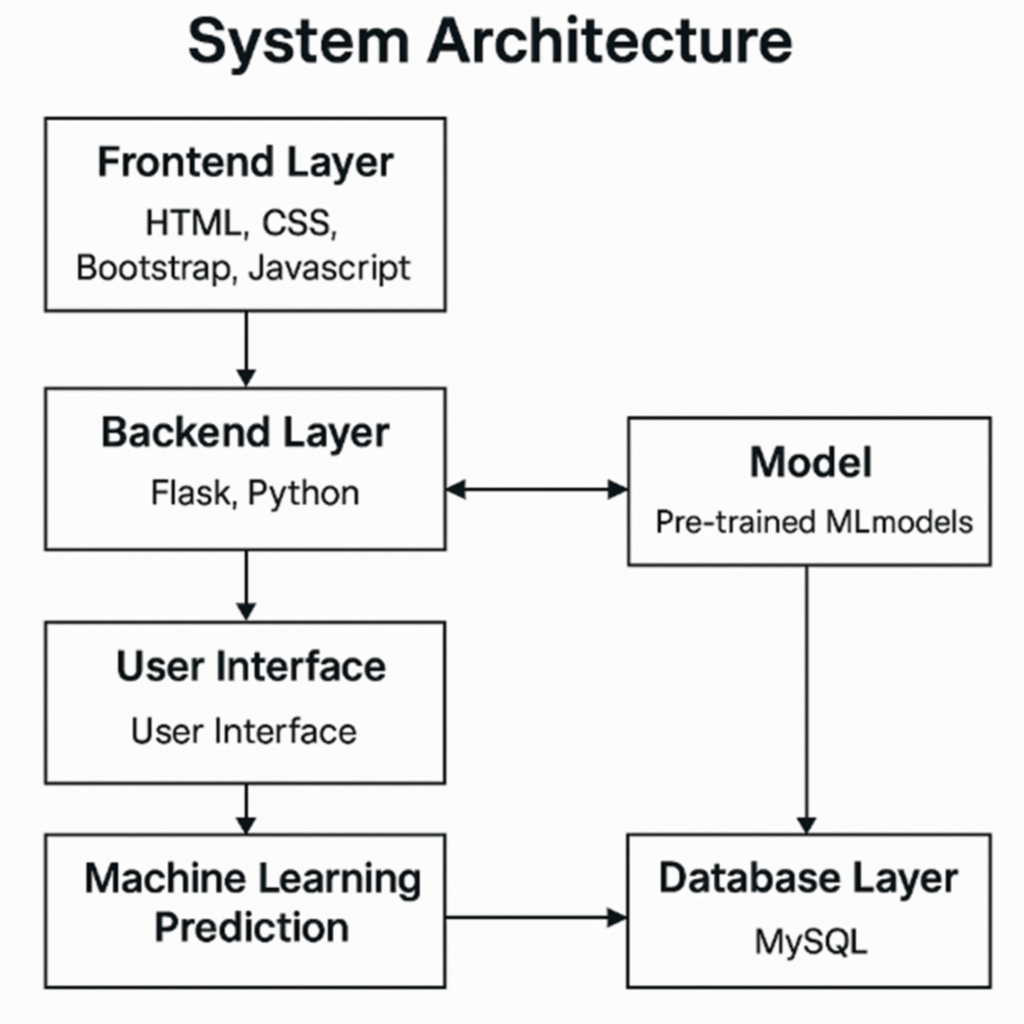
The platform follows a three-layer architecture consisting of:
- User Interface Layer – Collects and validates input data.
- Application Layer – Executes machine learning models via Flask APIs.
- Database Layer – Stores records securely in MySQL.
Pre-trained models are stored as serialized files and dynamically loaded during prediction. RESTful communication ensures seamless data flow between components.
Conclusion
The AI infertility prediction system successfully demonstrates how machine learning can support early detection of male and female infertility. By integrating neural networks and ensemble models, the platform delivers reliable and scalable fertility risk assessments.
A secure, user-friendly web application ensures practical usability in real-world healthcare environments, making this system a valuable tool for clinicians, researchers, and individuals seeking preliminary fertility screening.
Future Scope
Future enhancements include incorporating additional hormonal markers, integrating ultrasound image analysis, developing mobile applications, and deploying the system on cloud platforms such as AWS or Azure.
Multilingual support, real-time analytics dashboards, and hospital system integration will further expand accessibility and clinical applicability.
What is an AI infertility prediction system?
A data-driven platform that predicts fertility risks using machine learning models.
Can it replace doctors?
No, it serves as a preliminary screening tool to assist medical professionals.
Is it safe for students?
Yes, it uses non-invasive data and secure storage.
Does it work for both genders?
Yes, it evaluates fertility risks for both males and females.
How accurate is the system?
Female model: ~89.2% accuracy; Male model: ~85.7% accuracy.
Are reports downloadable?
Yes, secure PDF reports are automatically generated.