Table of Contents
ABSTRACT
This college final year project introduces an innovative AI based virtual try on web portal designed to transform the fashion retail experience. The system allows users to register, set preferences such as gender and occasion, and receive personalized clothing recommendations. Using advanced AI-based virtual try on technology, users can visualize garments on realistic body shapes and sizes, reducing the need for physical trials and enhancing decision-making accuracy.
The platform incorporates machine learning algorithms to analyze user behavior and continuously refine suggestions, providing a highly personalized shopping experience. It also addresses common fashion industry challenges, including inaccurate size selection, high return rates, and limited personalization options. Features such as real-time garment rendering, scalable product catalog integration, and adaptive learning models improve user engagement and overall efficiency.
By promoting sustainable virtual try on practices and optimizing retail operations, this AI based virtual try on project offers a future-ready solution bridging technology and fashion. It equips users to make confident purchase decisions while serving as a practical and innovative college final year project for engineering, IT, and computer science students. Overall, the platform demonstrates a technologically advanced, environmentally conscious approach to modern fashion retail.
INTRODUCTION
Problem Statement
The fashion retail industry faces persistent challenges that impact both consumers and businesses, especially in the online shopping environment. A major issue is the difficulty for users to accurately visualize clothing fit and appearance, leading to confusion, wrong size selection, and dissatisfaction. This often results in high product return rates, increased operational costs for retailers, and frustration among shoppers.
Traditional e-commerce platforms typically offer generic suggestions that do not consider individual body types, fashion preferences, or style choices, resulting in a less engaging shopping experience. Physical try-on processes in stores are time-consuming and inconvenient, and they fail to meet the growing demand for fast, efficient, and personalized online shopping.
Moreover, frequent returns, overproduction, and unsustainable consumption contribute to a significant environmental impact. There is a clear need for a smart, AI based virtual try on solution that enhances clothing visualization, delivers personalized recommendations, and improves decision-making while promoting sustainable shopping practices.
This college final year project addresses these issues by developing an AI based virtual try on and recommendation system that increases accuracy, boosts shopper confidence, and improves overall satisfaction in online fashion retail. By combining machine learning algorithms with personalized clothing recommendations, the project provides a practical and innovative solution for modern e-commerce challenges, making it an ideal final year project for engineering, IT, and computer science students.
Objective of the Project
The main objective of this college final year project is to develop an AI Based Virtual Try on web platform that transforms the online fashion-shopping experience. The project combines advanced AI technology and machine learning to deliver personalized, accurate, and sustainable solutions for modern e-commerce.
The specific objectives include:
- Implement AI Based Virtual Try On Technology: Allow users to visualize garments on their own body shape using AI-powered body detection, segmentation, and clothing overlay techniques for realistic previews.
- Provide Personalized Fashion Recommendations: Utilize machine learning algorithms to analyze user preferences, browsing behavior, and purchase history, delivering tailored clothing suggestions.
- Enhance User Decision-Making and Convenience: Offer a seamless, interactive, and intuitive web interface accessible across multiple devices, ensuring efficient and enjoyable online shopping.
- Reduce Product Return Rates: Improve size accuracy, fit prediction, and garment visualization through AI Based Virtual Try On, minimizing incorrect purchases and retailer operational costs.
- Promote Sustainability in Fashion Retail: Support eco-friendly digital shopping practices by reducing unnecessary shipments, overproduction, and waste, contributing to a greener fashion industry.
- Boost Customer Satisfaction and Engagement: Deliver an intelligent, immersive, and user-centric shopping experience that enhances customer confidence, loyalty, and engagement.
By achieving these objectives, this AI Based Virtual Try On project addresses key challenges in fashion retail while serving as a high-impact college final year project for engineering, IT, and computer science students, providing hands-on experience with AI, machine learning, and e-commerce technologies.
Scope of the Project
The scope of this college final year project includes the design, development, implementation, and testing of a complete AI based virtual try on fashion retail system. The key components within the project scope are:
- User Authentication and Profile Management:
Secure login, profile creation, and storage of user preferences for a personalized shopping experience. - Product Catalog and Filter System:
Display categorized clothing items with detailed product information and interactive browsing options. - AI based virtual try on Module:
Integration of AI and computer vision techniques to superimpose garments onto the user’s body image in real time, providing an accurate virtual fitting experience. - Personalized Recommendation Engine:
Machine learning models that generate tailored clothing suggestions based on user behavior, preferences, and browsing history. - Shopping Cart and Order Flow (Optional for Prototype):
Basic cart functionality to simulate the end-to-end shopping experience. - Admin Panel (Optional):
Management of products, categories, and user data for streamlined system operations. - Cross-Device Accessibility:
Ensuring smooth functionality across desktops, laptops, and mobile devices for a seamless user experience.
Out of Scope (Not Included Unless Extended):
- Large-scale commercial deployment
- Integration with real retail backend systems
- Physical garment measurement automation
Overall, the project focuses on developing a functional prototype that demonstrates how AI based virtual try on and personalized recommendations can enhance accuracy, convenience, and user satisfaction in online fashion shopping.
SYSTEM REQUIREMENTS SPECIFICATION
The System Requirements Specification (SRS) defines the essential software, hardware, and operational needs required to develop, deploy, and maintain the AI based virtual try on fashion retail system. These requirements ensure the system functions efficiently, securely, and provides a seamless user experience for both students and online shoppers.
Software Requirements
The software requirements outline the platforms, tools, and frameworks necessary for implementing the AI based virtual try on system:
Operating System
- Windows 10/11, Linux (Ubuntu), or macOS
Programming Languages
- Python – for AI, machine learning, and backend logic
- JavaScript – for frontend interactivity
- HTML5, CSS3 – for UI/UX design
Web Development Frameworks
- Frontend: React.js / Angular / Vue.js
- Backend: Django or Flask for API integration
- RESTful API support for communication between modules
AI and Machine Learning Libraries
- TensorFlow / PyTorch – for deep learning-based AI based virtual try on
- OpenCV – for image processing and body segmentation
- Scikit-learn – for personalized recommendation algorithms
- NumPy, Pandas – for data handling and computation
Database Management System
- MySQL / PostgreSQL – for storing users, products, preferences, and history
- Firebase / MongoDB (optional) – for cloud-based data storage
Development Tools
- Visual Studio Code / PyCharm
- Git & GitHub for version control
- Postman for API testing
Testing Tools
- Selenium – for UI testing
- PyTest / UnitTest – for backend testing
- JMeter (optional) – for load testing
Hardware Requirements
The hardware requirements specify the necessary physical resources for running the AI based virtual try on system:
Client-Side Requirements (User Devices)
- Computer / Laptop / Smartphone
- Minimum 2 GB RAM
- Built-in or external camera for AI based virtual try on
- Stable internet connection (5 Mbps or above)
Server-Side Requirements
- Processor: Minimum Intel i5 or equivalent
- RAM: 8 GB or higher
- Storage: 100 GB or more
- GPU (Recommended): NVIDIA CUDA-enabled GPU for training and running AI models
Additional Hardware
- External storage for backups
- High-performance GPU servers (optional for large-scale deployments)
Functional Requirements
Functional requirements define the core features and behaviors the system must support:
User Authentication
- Users can register, log in, and update profiles securely.
- Password encryption and validation must be enforced.
Product Browsing
- Browse clothing items by category, size, color, price, etc.
- Search and filter functionality available.
AI Based Virtual Try On Module
- Users can virtually try on clothing using AI-based body detection and overlay techniques.
- Garments are rendered accurately on the user’s body image in real time.
Personalized Recommendation System
- Analyze user behavior and preferences to suggest tailored clothing items.
- Recommendations update dynamically as user activity evolves.
Shopping Cart and Checkout (Optional)
- Users can add items to a cart and simulate orders.
- Admins can manage purchase records.
Admin Panel
- Add, edit, or remove products and categories.
- Manage users and view system analytics.
Reporting and Analytics
- Generate insights on user activity, product popularity, and fashion trends.
Responsive User Interface
- Ensure smooth functionality across desktops, tablets, and smartphones.
Non-Functional Requirements
Non-functional requirements define the system’s quality attributes such as performance, security, usability, and sustainability:
Performance Requirements
- Pages should load within 3–5 seconds.
- AI based virtual try on must render with minimal delay.
- Support multiple concurrent users without performance degradation.
Security Requirements
- Encrypt user data using SSL/TLS.
- Secure authentication with hashed passwords.
- Role-based access control for user and admin modules.
Reliability and Availability
- Maintain at least 95% uptime.
- Implement backup and recovery mechanisms.
Usability Requirements
- Intuitive, easy-to-navigate, visually appealing interface.
- Accessible to users with minimal technical knowledge.
Scalability
- Scale horizontally or vertically to handle increased user traffic.
- Modular architecture for easy feature expansion.
Maintainability
- Follow proper code naming conventions and documentation.
- Simplify updates and future enhancements.
Compatibility
- Cross-browser support: Chrome, Firefox, Edge, Safari.
- Compatible with various devices and screen resolutions.
Sustainability
- Minimize computational load to reduce energy consumption.
- Reduce physical returns through AI based virtual try on, promoting eco-friendly retail practices.
Architecture Design
The proposed system follows a three-tier architecture designed to support scalability, maintainability, and efficient data flow for an AI based virtual try on fashion retail platform. This architectural approach separates concerns across layers, ensuring smooth interaction between the user interface, application logic, and data management components.
Presentation Layer (Frontend)
The presentation layer is responsible for user interaction and visual representation of the system. It provides an intuitive and responsive interface that allows users to:
- Register and log in securely
- Browse fashion products and apply filters
- Upload images or capture live images using a camera
- View realistic garment previews generated through AI based virtual try on
- Interact with personalized recommendations
This layer focuses on delivering a seamless user experience across desktops, laptops, and mobile devices while rendering virtual try-on outputs in real time.
Application Layer (Backend + AI Services)
The application layer manages the core business logic and AI processing required for the system. It includes:
- User authentication and profile management
- Product catalog handling and filtering logic
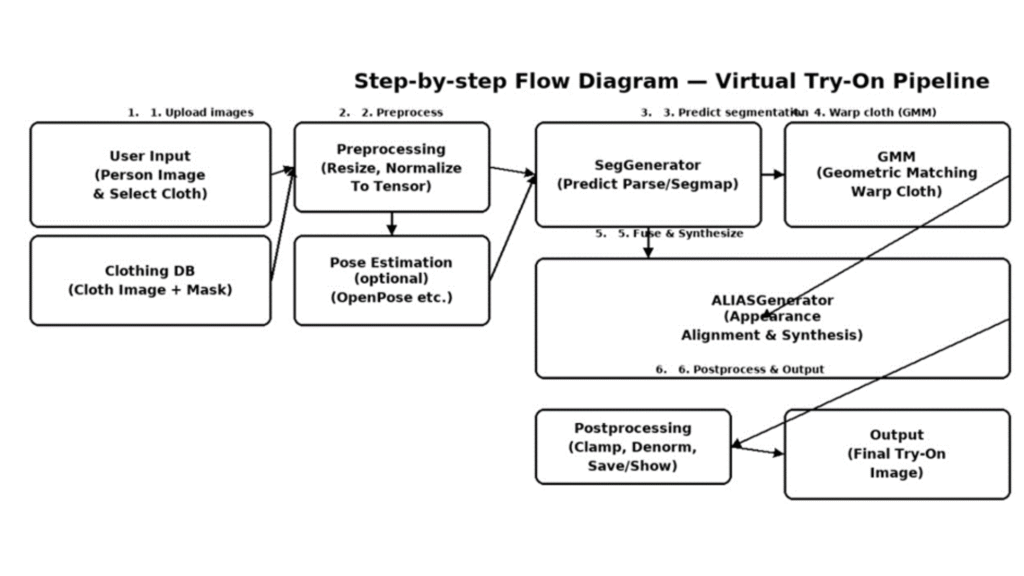
- AI based virtual try on processing, including body detection, image segmentation, and garment overlay
- Personalized recommendation engine powered by machine learning algorithms
- Shopping cart management and order simulation
- Admin functionalities such as product management and analytics
This layer acts as the bridge between the frontend and the data layer, ensuring secure and efficient processing of user requests.
Data Layer (Database and Storage)
The data layer stores and manages all persistent system data, including:
- User profiles and preferences
- Product details and images
- Transaction and activity logs
- Recommendation history and analytics data
- Image assets used for AI based virtual try on processing
Structured databases and scalable storage solutions ensure data integrity, fast retrieval, and support for future system expansion.
Data Flow and Integration
Data flows seamlessly between the presentation, application, and data layers using RESTful APIs and dedicated AI inference endpoints. This modular and service-oriented architecture enables easy maintenance, efficient debugging, and smooth integration of new features.
Overall, the architecture design provides a robust foundation for implementing an AI based virtual try on system that is flexible, scalable, and suitable for real-world fashion retail applications as well as academic final year projects.
CONCLUSION
The development of the AI based virtual try on and fashion recommendation system represents a major step forward in modern digital retail innovation. By effectively integrating computer vision, machine learning, and user-centric design principles, the project successfully overcomes key limitations of traditional online shopping platforms—most notably inaccurate garment visualization, lack of personalization, and high product return rates.
The system enables users to experience a realistic and interactive AI based virtual try on, allowing them to visualize how garments fit and appear on their own body profile. This significantly improves decision-making accuracy and boosts user confidence during online purchases. In addition, the personalized recommendation engine enhances the shopping journey by suggesting clothing items aligned with user preferences, body characteristics, and browsing behavior, resulting in a more engaging and efficient shopping experience.
From a technical perspective, the modular architecture, responsive interface, and secure system design ensure scalability, maintainability, and compliance with modern software engineering standards. Administrative tools support efficient product and content management, while analytics modules provide valuable insights into user engagement and product performance.
Overall, this project demonstrates how AI based virtual try on solutions can transform the fashion retail industry by enhancing user experience, improving operational efficiency, and supporting sustainability through reduced product returns. The successful implementation establishes a strong foundation for future technological expansion, positioning the system as a future-ready solution for intelligent and personalized fashion retail.
FUTURE SCOPE
The AI based virtual try on and AI-powered fashion recommendation system offers extensive opportunities for future enhancement, real-world deployment, and technological expansion. As fashion retail and digital technologies continue to evolve, the system can be upgraded to deliver an even more immersive, intelligent, and scalable shopping experience.
1. Augmented Reality (AR) Integration for Real-Time Try On
Future versions can incorporate AR-based AI based virtual try on, allowing users to try garments through live camera feeds instead of static images. This would:
- Provide a dynamic and interactive fitting experience
- Adjust garments based on movement and posture
- Improve realism and visual accuracy
2. Full 3D Body Scanning and Avatar Creation
The system can evolve to support:
- 360-degree body scanning
- Personalized 3D avatar generation
- Precise body measurement extraction
This would greatly enhance size prediction and realism in AI based virtual try on simulations.
3. Advanced Fabric and Physics Simulation
Future enhancements may include physics-based simulations to model:
- Fabric draping and stretching
- Cloth flow and texture deformation
- Material-specific behavior
Such features would make virtual fittings nearly identical to real-world try-ons.
4. Voice-Based and Chatbot-Assisted Shopping
AI-powered conversational assistants can guide users through:
- Style recommendations
- Virtual styling sessions
- Product discovery
- Automated customer support
This would improve engagement and provide 24/7 intelligent assistance.
5. Deep Learning-Driven Recommendation Enhancement
Future recommendation engines may integrate:
- Emotion and mood recognition
- Occasion-based styling
- Seasonal and regional trends
- Social media fashion analysis
These enhancements would make personalization more intuitive and context-aware.
6. Cloud Deployment and Commercial Scalability
Deploying the AI based virtual try on system on cloud platforms would enable:
- High scalability and performance
- GPU-accelerated AI processing
- Integration with large fashion retailers
- Support for millions of concurrent users
7. Social Try On and Virtual Fashion Events
Future features could allow users to:
- Attend virtual fashion shows
- Share try-on results on social platforms
- Receive feedback from friends
- Build virtual wardrobes
This promotes community-driven and interactive shopping.
8. Sustainability-Focused Fashion Intelligence
The system can integrate sustainability metrics such as:
- Eco-friendly fabric indicators
- Carbon footprint information
- Ethical manufacturing ratings
This enables users to make environmentally responsible fashion choices.
9. Integration with Physical Retail Stores
Future development may include:
- Smart mirrors
- IoT-enabled clothing tags
- Contactless in-store AI based virtual try on
- Retail analytics and customer behavior tracking
This bridges the gap between online and offline shopping.
10. Global Expansion Capabilities
Enhancements may include:
- Multi-language support
- Multi-currency transactions
- Regional fashion customization
- Global payment gateway integration
11. AI-Powered Size Prediction
Advanced AI models can predict ideal garment size based on:
- Body shape and measurements
- Fit preferences (tight, regular, loose)
- Brand-specific sizing variations
This would significantly reduce size-related returns.
What is AI based virtual try on?
AI based virtual try on is a technology that uses artificial intelligence and computer vision to allow users to visualize how clothing will look and fit on their body digitally. It overlays garments onto user images or live camera input, improving accuracy and confidence in online fashion shopping.
How does AI based virtual try on work?
AI based virtual try on works by detecting the user’s body shape using image processing and machine learning algorithms. The system segments the body image and accurately superimposes selected garments, adjusting size, alignment, and proportions in real time.
Why is AI based virtual try on important for online fashion retail?
AI based virtual try on helps reduce incorrect size selection, lowers product return rates, and enhances customer satisfaction. It provides a more interactive and personalized shopping experience compared to traditional online fashion platforms.
What technologies are used in an AI based virtual try on system?
An AI based virtual try on system typically uses computer vision, deep learning frameworks, image segmentation techniques, and machine learning models. Technologies such as Python, OpenCV, TensorFlow or PyTorch, and web frameworks are commonly used.
Is AI based virtual try on suitable for a college final year project?
Yes, AI based virtual try on is an excellent college final year project as it combines AI, machine learning, web development, and real-world problem solving. It is highly relevant, innovative, and aligns well with current industry trends.
How does AI based virtual try on support sustainable fashion?
AI based virtual try on supports sustainability by reducing unnecessary product returns, minimizing waste, and lowering carbon emissions caused by logistics. It encourages informed purchasing decisions and promotes eco-friendly digital shopping practices.