A Complete Final Year Project Guide for Engineering Students in India
Table of Contents
Introduction
Automated Cycle Chain Maintenance System is a practical solution designed for modern chain-driven mechanisms used in bicycles, motorcycles, industrial conveyor belts, and automated machinery. In India, where bicycles and two-wheelers are widely used for daily commuting and industrial automation is rapidly expanding, the reliability and efficiency of chain systems play a crucial role in overall performance and safety.
Despite their importance, chain maintenance is often neglected due to its manual, time-consuming, and messy nature. Improper cleaning and lubrication lead to increased friction, energy loss, corrosion, and premature chain failure. To address these real-world challenges, this automated cycle chain maintenance system using Arduino has been developed as an innovative and industry-relevant final year engineering project.
The project automates the routine process of chain cleaning and lubrication using an Arduino Uno microcontroller, eliminating the need for frequent human intervention while ensuring consistent, precise, and timely maintenance. This system is especially suitable for engineering diploma, BE/BTech, and polytechnic final year students in India who are looking for a hardware-based project with strong real-world applicability and academic value.
Why Automated Chain Maintenance Matters?
Manual chain maintenance suffers from multiple drawbacks:
- Irregular servicing schedules
- Inconsistent lubrication
- Excessive wear due to dirt accumulation
- Increased operational downtime
- Higher long-term maintenance costs
By automating this process, the system ensures:
- Maintenance is performed only when required
- Optimal lubricant usage
- Uniform cleaning
- Extended chain lifespan
From an academic perspective, this project demonstrates the practical application of embedded systems, sensors, motors, and automation, aligning well with modern engineering curricula in India.
Problem Statement
Chain-driven systems used in bicycles, motorcycles, and industrial conveyor mechanisms depend heavily on regular cleaning and lubrication for smooth operation. However, traditional manual maintenance methods are inefficient and inconsistent. The absence of timely maintenance causes dirt accumulation, increased friction, uneven wear, and eventual chain failure. The Automated Cycle Chain Maintenance System aims to eliminate these issues through systematic automation.
Manual chain maintenance suffers from several limitations, including excessive time consumption, dependency on human effort, inconsistent lubrication, and frequent neglect. In industrial environments, chain failure can cause downtime and financial losses. The Automated Cycle Chain Maintenance System is designed to overcome these problems by tracking chain usage and triggering maintenance automatically based on actual operation rather than guesswork.
By implementing the Automated Cycle Chain Maintenance System, users can ensure reliable, timely, and consistent maintenance that improves chain lifespan and operational efficiency.
Objectives of the Project
The primary objective of the Automated Cycle Chain Maintenance System is to automate the process of cleaning and lubricating a cycle chain with minimal human intervention. This system ensures that maintenance is performed at optimal intervals, preventing both neglect and over-maintenance.
Key objectives of the Automated Cycle Chain Maintenance System include:
- Automating chain cleaning and lubrication using Arduino Uno
- Monitoring chain usage based on distance traveled
- Ensuring uniform and precise lubricant application
- Reducing time, effort, and lubricant wastage
- Improving chain lifespan and mechanical efficiency
The Automated Cycle Chain Maintenance System is also designed to be user-friendly and adaptable, making it suitable for bicycles, motorcycles, and industrial conveyor systems.
Overview of the Proposed System
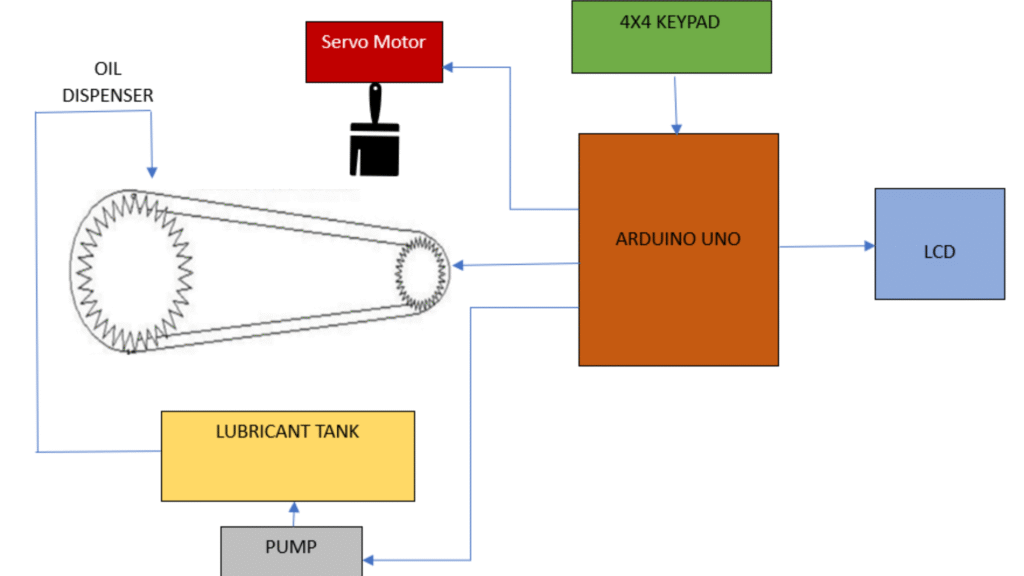
The Automated Cycle Chain Maintenance System operates using a conveyor-based chain mechanism controlled by an Arduino Uno microcontroller. The user inputs a distance threshold using a 4×4 keypad, which is displayed on an LCD screen for confirmation. As the chain operates, an IR sensor continuously monitors chain rotations.
Once the preset distance is reached, the Automated Cycle Chain Maintenance System automatically initiates the maintenance cycle. A servo motor lowers a cleaning brush onto the chain, allowing it to rotate against the brush for a fixed duration. After cleaning, a lubricant pump is activated to apply oil evenly across the chain. This automated process ensures optimal chain performance and reduced wear.
The Automated Cycle Chain Maintenance System provides precise control, consistent operation, and reliable performance, making it an ideal automation-based final year project.
System Architecture and Working Principle
Working Flow:
- User enters distance threshold via keypad
- Value is displayed on LCD for confirmation
- IR sensor tracks chain rotations
- Arduino calculates distance traveled
- When threshold is reached:
- Cleaning brush activates
- Lubrication pump dispenses oil
- System resets for next cycle
This approach ensures maintenance based on actual usage, not assumptions.
Block Diagram
Hardware Components Used
Arduino Uno
The Arduino Uno acts as the central controller of the Automated Cycle Chain Maintenance System. It processes input from the keypad and IR sensor while controlling motors, relays, and the LCD display. The Arduino Uno ensures synchronized operation of all components within the Automated Cycle Chain Maintenance System.
Key features:
- 14 digital I/O pins
- 6 analog inputs
- I2C and SPI communication
- Easy programming via Arduino IDE
It coordinates all system components to ensure synchronized operation.
DC Motors
DC motors are used to drive the conveyor chain mechanism in the Automated Cycle Chain Maintenance System. These motors provide controlled and consistent chain movement during cleaning and lubrication.
Key roles:
- Maintain constant chain movement
- Provide sufficient torque under load
- Enable speed control via PWM
L298 Motor Driver
The L298 motor driver interfaces between the Arduino Uno and the DC motors in the Automated Cycle Chain Maintenance System. It enables bidirectional motor control and speed regulation using PWM. It allows:
- Bidirectional motor control
- Speed regulation using PWM
- Handling of higher currents safely
Its dual H-bridge design makes it ideal for conveyor applications.
IR Sensor
The IR sensor detects chain rotations using a reflective marker. Each detection pulse helps the Arduino calculate distance traveled.
Advantages:
- Non-contact sensing
- High accuracy
- Low power consumption
Relay Module
The relay module safely controls the lubricant pump. It allows low-voltage Arduino signals to switch high-power devices without risk.
Lubricant Pump
The lubricant pump dispenses oil evenly after the cleaning cycle. Controlled via relay, it ensures:
- Proper lubrication
- Minimal wastage
- Reduced friction
LCD Display (16×2)
The LCD provides real-time system feedback such as:
- Distance threshold
- Chain rotation count
- Maintenance status
This enhances usability and transparency.
4×4 Keypad
The keypad enables user input for:
- Distance threshold
- System control commands
It offers a simple and intuitive interface.
Power Supply
A 12V DC power supply powers motors and pump, while onboard regulation provides 5V to the Arduino and sensors. This ensures stable and safe operation.
Advantages Over Existing Manual Systems
- Fully automated maintenance
- Consistent cleaning and lubrication
- Reduced time and labor
- Minimal mess and wastage
- Improved chain lifespan
- Adaptable for multiple applications
Applications and Real-World Use Cases
- Bicycles and e-bikes
- Motorcycles and scooters
- Industrial conveyor belts
- Agricultural machinery
- Manufacturing automation systems
Scope for Enhancement and Future Work
- IoT-based monitoring
- Mobile app integration
- Oil level detection
- Machine learning-based maintenance prediction
- Solar-powered operation
Why This Is a Strong Final Year Project Choice
This project is ideal for Indian final year students because it:
- Uses affordable components
- Demonstrates practical automation
- Aligns with core engineering subjects
- Has strong viva and evaluation value
- Offers real-world industrial relevance
Conclusion & Project Support CTA
The Automated Cycle Chain Maintenance System using Arduino is a practical, innovative, and industry-relevant final year project that addresses real-world mechanical maintenance challenges. By combining embedded systems, automation, and user-friendly design, this project showcases engineering skills that are highly valued in both academia and industry.
👉 Need complete project support?
We provide:
- Full project kit
- Source code
- Circuit diagrams
- Project report (IEEE/college format)
- Viva preparation support
Is this project suitable for BTech mechanical or ECE students?
Yes, it is ideal for Mechanical, ECE, EEE, and Mechatronics students.
Can this project be extended using IoT?
Yes, it can be enhanced with cloud monitoring and mobile alerts.
Is Arduino Uno enough for this system?
Yes, Arduino Uno efficiently handles all required operations.
Can this be used for industrial conveyor belts?
Yes, with minor modifications, it can be adapted for industrial use.
Does this project have good viva scope?
Absolutely. It covers automation, sensors, motors, and control logic.
Is documentation provided for college submission?
Yes, complete project documentation is available.